Unit 4: The Practice of Longevity Coaching
Chapter 4.29: Course Conclusion & Certification
[CHONK: 1-minute summary]
What you'll learn in this chapter:
- A synthesis of everything you've learned across all four units and 27 chapters
- The key models and tools that will guide your practice: Deep Health, Hierarchy of Longevity Needs, Triangle of Care
- How to apply the Deep Health framework to yourself. Coaches who practice what they teach are more effective
- How to prepare for your certification assessment
- Where to go next: continuing education, community, and professional development
The big idea: You've completed an incredible learning journey. Over 27 chapters, you've mastered the foundations of longevity coaching, from the biology of aging to the art of behavior change, from evidence-based interventions to the business of building a practice. This chapter brings it all together, helps you prepare for certification, and sets you up for what comes next. Because this isn't the end. It's the beginning of your practice.
[CHONK: Change is Powerful - Completing Your Journey]
Change is Powerful
Congratulations.
You've almost made it through the L1 Longevity Certification.
Take a moment to recognize what you've accomplished. Over four units and 27 chapters, you've learned the science of aging, the art of coaching, and the practical skills needed to help people live longer, healthier lives. You've studied everything from mitochondrial health to motivational interviewing, from biomarkers to business models.
That's no small thing.
But we want you to understand something important: completing this certification isn't the end of something. It's the beginning.
Self-coaching builds belief
Throughout Unit 4, you've been doing more than learning concepts. You've been practicing them. You've reflected on your own Deep Health. You've applied these concepts to yourself. You've thought about your own longevity journey.
This matters.
When you've experienced the process of change yourself, really felt what it's like to identify barriers, test strategies, and build sustainable habits, you develop something invaluable: belief that change is possible.
That belief will come through in every coaching conversation. When a client doubts they can change their sleep habits, you'll speak from experience. When someone struggles with consistency, you'll understand. When they feel like giving up, you'll know what it takes to persist.
Self-coaching also gives you common ground with your clients. You can honestly say: "I've been where you are." Even if your specific goals differ, the emotions are universal: the frustration, the impatience, the small victories that feel huge, the setbacks that feel crushing. These are connection points that make you a more effective coach.
This is the beginning
Everything you've learned in this certification is preparation for practice. The real learning starts when you work with actual clients. When theory meets reality, when textbook cases become real people with messy lives.
That's exciting. And a little intimidating. Both reactions are normal.
From coaching over 150,000 clients at Precision Nutrition, we know that the coaches who succeed aren't the ones who memorize everything perfectly. They're the ones who internalize the fundamentals, stay curious, and keep learning.
You've built the foundation. Now it's time to build the practice.
[CHONK: The Journey Complete - What You've Learned]
The Journey Complete: What You've Learned
Let's take a quick tour through everything you've covered. This isn't just a summary. It's a reminder of how all the pieces fit together.
Unit 1: Foundations of Longevity Coaching
In Unit 1, you built the conceptual foundation for everything that followed. These six chapters established the "why," "what," and "how" of longevity coaching, and set the boundaries that keep your practice safe and effective.
Chapter 1: Introduction to Longevity Coaching introduced the crucial distinction between lifespan (how long you live) and healthspan (how long you live well). You learned about compression of morbidity, the goal of extending healthy years while compressing the period of decline at the end of life. The data here is striking: the global median gap between life expectancy and healthy life expectancy is about 9 years. That's 9 years of potential decline that coaching can help reduce. You also explored your own "longevity why", the personal motivation that will fuel your practice even when the work gets hard.
Chapter 2: The Biology of Aging took you inside the cellular and molecular processes that drive aging. You learned about the hallmarks of aging: genomic instability, telomere attrition, epigenetic alterations, loss of proteostasis, deregulated nutrient sensing, mitochondrial dysfunction, cellular senescence, stem cell exhaustion, and altered intercellular communication. This wasn't academic trivia; understanding these mechanisms helps you explain why interventions work (or don't) and keeps you grounded in evidence rather than hype. When a client asks why sleep matters for longevity, you can now explain the connection to cellular repair processes.
Chapter 3: Deep Health & The Longevity Mindset introduced the organizing principle for this entire certification: the Deep Health framework. You learned that longevity isn't just about physical health. It's about thriving across six interconnected dimensions: Physical, Emotional, Mental/Cognitive, Social/Relational, Environmental, and Existential. You also discovered how mindset affects biological aging. The research is remarkable: people with positive self-perceptions of aging live an average of 7.5 years longer than those with negative perceptions. Purpose matters too. People without a sense of ikigai (life purpose) have 50% higher all-cause mortality.
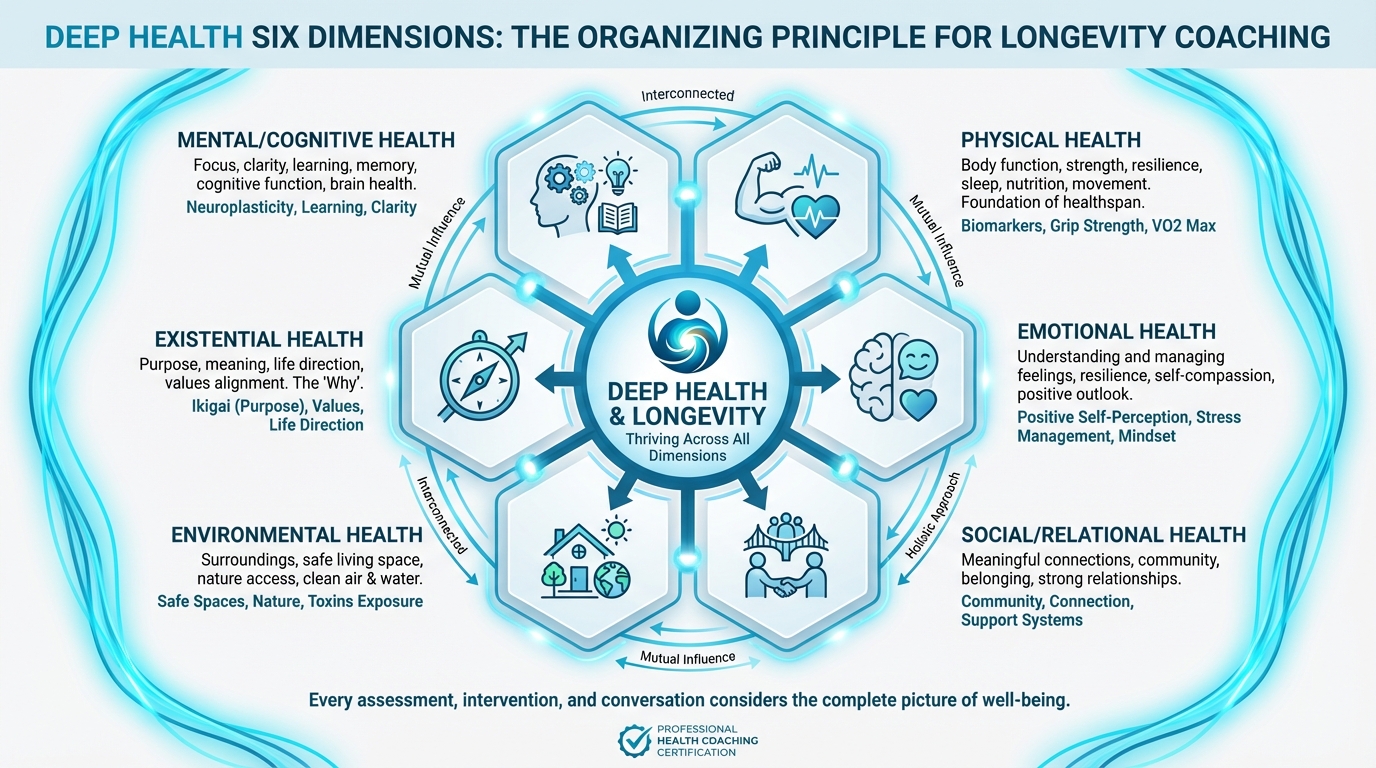
Figure: Visual of interconnected dimensions (final version)
Chapter 4: Assessment & Biomarkers covered what to measure (and what not to measure), how to interpret data within your scope, and how to use the Deep Health Questionnaire to assess clients in a whole-person way. You learned about the biomarkers that actually predict healthspan: from VO2 max to grip strength to metabolic markers. You also learned the difference between what's interesting to know and what's actionable for coaching.
Chapter 5: Scope of Practice & Medical Collaboration established the critical boundaries that protect both you and your clients. You learned what coaches can and cannot do, how to work within the Triangle of Care (client, coach, physician), and when to refer. This chapter underlies everything else. Every intervention we discussed in later chapters must stay within these boundaries. Scope isn't about limiting you; it's about ensuring you help in ways that are legal, ethical, and safe.
Chapter 6: The Longevity Coaching Process showed you how to apply PN's 6-step coaching process specifically to longevity. You learned that longevity coaching requires decades-long thinking, not weeks. You discovered the 3-month phased onboarding strategy that prevents overwhelm and builds sustainable change. You learned how to build systems that support clients for years, because longevity isn't a 12-week program.
Unit 2: Core Interventions (The Protocol)
In Unit 2, you learned the evidence-based lifestyle interventions that form the foundation of longevity coaching. These eight chapters gave you the "what," the specific strategies that move the needle on healthspan.
Chapter 7: Nutrition for Longevity covered the biochemistry of food and aging. You learned about Mediterranean and MIND diet principles, not as rigid prescriptions, but as evidence-based patterns that support cellular health. You learned about protein requirements for preventing sarcopenia (age-related muscle loss), with targets of 1.2-1.6g per kilogram of body weight for older adults. You learned that nutrition for longevity isn't about restriction, it's about adequate protein, colorful vegetables, and minimizing processed foods.
Chapter 8: Metabolic Health & Nutrition Timing went deeper into blood sugar management, insulin sensitivity, and metabolic flexibility. You learned about time-restricted eating (TRE) and fasting protocols: what the evidence actually shows, who benefits, and who should be cautious. You learned about the important gender differences in fasting responses, and why women may need different approaches than men.
Chapter 9: Exercise: The Longevity Drug established physical activity as the single most powerful longevity intervention we have. The evidence is staggering: meeting physical activity guidelines reduces all-cause mortality by 20-40%. Each additional 1,000 steps per day is associated with roughly 9% lower mortality risk. You learned about strength training as "the currency of aging", because muscle mass and function predict independence and survival. You learned about Zone 2 training for mitochondrial efficiency and why VO2 max is emerging as a vital sign.
Chapter 10: Movement Quality & Stability covered the functional capacities that determine quality of life: mobility, balance, and fall prevention. You learned about the "get up from the floor" test and other functional assessments. Because living to 90 doesn't mean much if you can't get up when you fall down.
Chapter 11: Sleep Optimization addressed the foundation that affects everything else. You learned about the glymphatic system: how sleep literally clears waste from your brain, and why poor sleep is linked to cognitive decline. You learned about circadian rhythms, light exposure, and practical sleep hygiene protocols. Short sleep (under 7 hours) is associated with 14% higher mortality; this isn't optional.
Chapter 12: Stress & Mental Health taught you to distinguish hormetic stress (the good kind: exercise, cold exposure, cognitive challenges) from toxic stress (chronic, unrelenting, damaging). You learned about the neurobiology of chronic stress and how it accelerates aging. You learned about cognitive health, neuroplasticity, and BDNF, the "fertilizer" for your brain.
Chapter 13: Recovery & Regeneration covered heat and cold exposure protocols. You learned what the evidence actually shows about sauna (4+ sessions weekly associated with 40% lower cardiovascular mortality in Finnish studies) and cold plunges (promising but less established). You learned about passive recovery techniques and how to balance stress and recovery.
Chapter 14: Environmental Health addressed the often-overlooked dimension of where you live and what you're exposed to. You learned about toxin exposure—PFAS, air pollution, water quality—and total toxic burden. You discovered that creating a pro-longevity environment isn't just about what you do; it's about reducing exposures that accelerate aging.
Unit 3: Advanced Topics & Disease Prevention
In Unit 3, you went deeper into specific health concerns and populations. These seven chapters addressed the conditions that kill or disable most people, and the evidence-based strategies that reduce risk.
Chapter 15: Supplements for Longevity navigated the complex world of supplements with scientific rigor. You learned what actually works (vitamin D, omega-3s, magnesium, creatine), what's promising but unproven (NMN, resveratrol), and what's marketing hype. Equally important, you learned how to evaluate evidence quality. So you can help clients avoid wasting hundreds of dollars monthly on supplements with weak evidence while missing foundational interventions that cost nothing.
Chapter 16: Cardiovascular Health addressed the #1 killer worldwide. You learned about lipids, ApoB (the best predictor of cardiovascular risk), and blood pressure, and the lifestyle interventions that reduce risk. You learned how to work within scope when clients bring you lab results, and when to encourage them to discuss medication options with their physicians.
Chapter 17: Metabolic Disease & Inflammation covered insulin resistance, Type 2 diabetes, and chronic inflammation ("inflammaging"). You learned that metabolic dysfunction underlies many age-related diseases, and that lifestyle interventions can dramatically improve metabolic health. You learned how to help clients prevent the diseases that shorten both lifespan and healthspan.
Chapter 18: Neuroprotection addressed the terrifying prospect of cognitive decline: Alzheimer's, Parkinson's, and other neurodegenerative conditions. You learned about BDNF and brain-healthy habits. You learned that the same interventions that support cardiovascular health also support brain health, because the brain is highly vascular tissue. You learned that cognitive decline is not inevitable; it's modifiable.
Chapter 19: Cancer Risk Reduction covered the metabolic roots of cancer and lifestyle strategies for prevention. You learned about screening recommendations (within scope, you educate, physicians order) and how to help clients reduce modifiable risk factors without creating cancer anxiety.
Chapters 20-21: Hormone Health (Women and Men) addressed the hormonal transitions of midlife and beyond. You learned about perimenopause and menopause in women, andropause in men, and how to support clients through these transitions. You learned how to work effectively with physicians when hormone therapy is considered, because HRT and TRT are medical decisions, but lifestyle optimization is your domain.
Unit 4: The Practice of Longevity Coaching
In Unit 4, you put it all together. These six chapters (plus this one) bridge the gap between knowing and doing: between theory and practice.
Chapter 22: Integration & Prioritization gave you the most important model for practical coaching: the Hierarchy of Longevity Needs. You learned that ~70% of longevity outcomes come from Tier 1 basics (sleep, movement, basic nutrition, social connection, health basics). You learned to prioritize ruthlessly, because a client obsessing over cold plunges while sleeping 5 hours is majoring in the minor. You learned to build 12-month roadmaps that sequence interventions appropriately: foundation first, then optimization.
Chapter 23: Case Study - The "Young" Senior brought these concepts to life through the proactive 60-year-old client. You practiced applying everything you'd learned to a real coaching scenario: someone who's motivated, relatively healthy, and wants to optimize for the decades ahead.
Chapter 24: Case Study - The "Overwhelmed" Mid-Lifer challenged you with a different profile: the stressed 45-year-old executive with no time, no energy, and competing demands. You learned how to coach someone who "knows what to do but can't seem to do it", one of the most common scenarios you'll face.
Chapter 25: Case Study - Complex Cases emphasized collaboration. You worked through scenarios involving existing medical conditions, multiple medications, and the need for careful coordination with physicians. You learned that complex cases are where the Triangle of Care becomes essential.
Chapter 26: Behavior Change for the Long Haul addressed sustainability. You learned how to help clients maintain habits over decades, because longevity coaching isn't about 12-week transformations. You learned about health anxiety and orthosomnia (obsessive tracking that disrupts the very things you're trying to optimize). You learned how to help clients stay consistent when motivation fades, as it inevitably will.
Chapter 27: The Business of Longevity Coaching gave you practical guidance on structuring packages, pricing services appropriately, and building referral networks with medical professionals. Because even the best coaching skills don't matter if you can't build a sustainable practice.
And now, Chapter 28: bringing it all together and preparing you for what's next.
[CHONK: Key Frameworks & Concepts Review]
Key Frameworks & Concepts Review
Before you head into your certification assessment, let's review the major models and concepts you should have internalized. These are the tools you'll use in every coaching conversation.
1. The Six Dimensions of Deep Health
Deep Health is the organizing principle for longevity coaching. Every client assessment, every intervention, every conversation should consider all six dimensions:
| Dimension | Focus | Longevity Connection |
|---|---|---|
| Physical | Body function, energy, fitness | The foundation. Exercise, nutrition, sleep |
| Emotional | Feelings, emotional regulation | Optimism adds 7+ years; emotional resilience protects against stress damage |
| Mental/Cognitive | Thoughts, focus, cognitive health | Brain health, neuroplasticity, cognitive reserve |
| Existential | Purpose, meaning, "why" | Purpose reduces mortality risk by up to 50% |
| Social/Relational | Connections, community | Social connection reduces mortality as much as quitting smoking |
| Environmental | Surroundings, toxin exposure | Environmental factors influence biological aging |
Key insight: You can't optimize one dimension while ignoring the others. A perfect exercise program won't overcome chronic loneliness. Excellent nutrition can't compensate for lost purpose.
2. The Hierarchy of Longevity Needs
This hierarchy prevents "majoring in the minor": the trap of focusing on advanced interventions while neglecting the basics.
Tier 1 (Foundation, ~70% of outcomes): The Non-Negotiables
- Sleep: 7-9 hours consistently
- Movement: 150+ minutes weekly, including strength training
- Basic Nutrition: Adequate protein, vegetables, minimally processed foods
- Social Connection: Regular meaningful contact
- Health Basics: Annual bloodwork, no smoking, moderate alcohol
Tier 2 (Significant, ~20% of outcomes):
- Stress management practices
- Environment optimization
- Advanced nutrition (Mediterranean/MIND principles, nutrient timing)
Tier 3 (Minor, ~9% of outcomes):
- Supplements (core stack)
- Recovery protocols (sauna, cold exposure)
- Testing optimization
Tier 4 (Marginal, ~1% of outcomes):
- Biohacks and experimental interventions
- Precision optimization
- Cutting-edge protocols
Key insight: Don't biohack before you sleep. Tier 1 must be solid before moving up.
3. The Triangle of Care
This model defines how you work within the healthcare system:
        Client
       /      \
      /        \
   Coach ---- Physician
- You (Coach): Facilitate behavior change, provide education, support implementation of medical plans
- Physician: Diagnose, prescribe, interpret medical data, make medical decisions
- Client: At the center, making informed decisions with support from both
Key insight: Clear communication among all three parties leads to the best outcomes.
4. The PN 6-Step Coaching Process
The iterative cycle that guides all coaching work:
- Assess and gather data: Collect information, establish baseline
- Understand and explore: Build the full picture, understand motivations and barriers
- Strategize and plan: Create an action plan based on what you've learned
- Choose and test: Select one action to implement and test it
- Observe and monitor. Track what happens, gather data
- Analyze and evaluate. Evaluate results, decide what to do next
For longevity coaching: Think in decades, not weeks. Build systems, not just habits. Plan for the long game.
5. Scope of Practice Boundaries
What you CAN do:
- Share evidence-based information and education
- Facilitate behavior change
- Support implementation of licensed providers' treatment plans
- Collaborate with healthcare teams (with consent)
- Refer when needs exceed coaching
What you CANNOT do:
- Diagnose medical conditions
- Interpret medical data (labs, imaging)
- Prescribe or deprescribe medications
- Recommend specific supplements, brands, or dosages
- Provide nutrition consultation or meal plans (unless additionally credentialed)
- Deliver psychological therapeutic interventions
Key insight: When in doubt, don't. Refer to the appropriate professional.
[CHONK: Your Personal Deep Health Reflection]
Your Personal Deep Health Reflection
Before you coach others for longevity, it's valuable to apply this approach to yourself. Coaches who practice what they teach, even imperfectly, are more credible and effective.
This isn't about being perfect. It's about being intentional.
Your Longevity "Why" Revisited
Back in Chapter 1, we asked you to reflect on your personal "longevity why": the deeper motivation behind your interest in helping people live longer, healthier lives.
What do you want to be able to do at 80? At 90?
Get specific. Is it hiking with grandchildren? Traveling? Teaching? Gardening? Playing music?
Who do you want to be healthy for?
Beyond yourself, whose lives are affected by your longevity?
Coach as Model
A question that trips up many new coaches is: Do I have to be perfect at everything I teach?
The answer is no. But you do need to be intentional.
You don't need perfect sleep scores, optimal biomarkers, or a flawless diet. What you need is authenticity about your own journey. Clients respond to coaches who are honest about their struggles. It builds trust and creates common ground.
Bill, from the SSR case studies, was a great sleeper but struggled with nutrition. That didn't make him a bad coach. It made him relatable. He understood what it felt like to know the right thing to do but not do it. That understanding made him more empathetic, not less credible.
[CHONK: The Longevity Coach's Commitment]
The Longevity Coach's Commitment
Coaching is a privilege. Clients trust you with their health, their vulnerabilities, and their aspirations. That trust deserves a commitment.
The following commitment reflects the values and standards of evidence-based, client-centered longevity coaching. It's not a legal document. It's a personal affirmation of the principles that guide ethical practice.
The Longevity Coach's Oath
I commit to the following principles in my practice as a longevity coach:
Evidence-Based Practice
I will base my coaching on the best available scientific evidence. I will distinguish between established findings and preliminary research. I will acknowledge uncertainty where it exists. I will not make claims that exceed what the evidence supports.
Client-Centered Approach
I will put my clients' interests first. I will respect their autonomy, values, and goals. I will meet them where they are, not where I think they should be. I will remember that the best plan is the one they can actually follow.
Scope Compliance
I will stay within my scope of practice. I will not diagnose, prescribe, or provide services that require licensure I do not hold. I will refer clients to appropriate professionals when their needs exceed my scope. I will work collaboratively within the Triangle of Care.
Continuous Learning
I will remain a student of longevity science. I will stay current with evolving research. I will revise my understanding when new evidence emerges. I will seek feedback and improve my practice over time.
Integrity and Honesty
I will be honest with clients about what coaching can and cannot accomplish. I will not oversell outcomes or make guarantees. I will acknowledge my own limitations. I will maintain appropriate professional boundaries.
Do No Harm
I will prioritize my clients' safety. I will recognize when an intervention may be harmful. I will not recommend practices that put clients at unnecessary risk. I will act with their long-term wellbeing in mind.
[CHONK: Preparing for Certification]
Preparing for Certification
You're ready for this. You've done the work. Now let's talk about what to expect and how to approach the assessment.
Exam Format
The certification assessment consists of:
- Multiple choice questions: Approximately 10 questions per chapter
- Open book: You can reference course materials during the exam
- No time limits: Work at your own pace
- Interactive activity: Completed as a separate activity from the course content
The open-book format is intentional. We're not testing memorization, we're testing understanding and application. The questions require you to think, not just recall.
Study Strategies That Work
1. Review the key concepts first
The key frameworks (Deep Health, Hierarchy of Longevity Needs, Triangle of Care, 6-Step Process, Scope Boundaries) appear throughout the exam. Make sure you understand these deeply, not just superficially.
2. Review your notes
The exercises you completed throughout the course are excellent preparation. They've already prompted you to apply concepts in ways the exam will test.
3. Practice explaining concepts to others
If you can explain something simply, you understand it. Try teaching key concepts to a friend, colleague, or even an imaginary client. Where you stumble is where you need more review.
4. Focus on application, not memorization
The exam tests whether you can apply knowledge to coaching scenarios. Think about how concepts would play out with real clients, not just what the definitions are.
5. Don't overthink it
The questions are designed to test understanding, not trick you. If you've engaged with the material honestly, you're prepared.
Common Areas of Difficulty
Based on student feedback, these areas often need extra attention:
Scope boundaries: What exactly can coaches do vs. cannot do? Review Chapter 5 carefully. When in doubt, the answer is usually "refer to a qualified professional."
Using the right tools: When should you use which framework? Practice thinking through client scenarios and which tools apply.
Case study reasoning: The exam may present scenarios and ask what you would do. Think through the process systematically. Don't just guess.
What to Expect After Passing
Once you pass the certification assessment:
- You'll receive your official PN L1 Longevity Certification credential
- You can list your certification on your professional profiles
- You'll have access to ongoing resources and the certification community
- You can begin applying what you've learned with clients
[CHONK: What Comes Next]
What Comes Next
Certification is a milestone, not a destination. Here's how to continue growing.
Continuing Education Pathways
Level 1 Nutrition Certification
If you haven't already, the L1 Nutrition Certification provides the foundational nutrition coaching skills that complement your longevity expertise. It's the world's #1 nutrition coaching certification, with over 175,000 graduates.
Level 1 Sleep, Stress Management & Recovery Certification
The L1 SSR Certification goes deeper into three pillars that underpin longevity: sleep, stress, and recovery. If your clients struggle with these areas, this certification will sharpen your skills.
Level 2 Master Health Coaching Certification
When you're ready to advance, the L2 Master Health Coaching Certification teaches advanced behavior-change psychology and complex client management. It's designed for experienced coaches who want to master the art of facilitating change.
PN Academy Premium
For ongoing education, PN Academy Premium ($49/month) includes:
- Research Insider: Clear, up-to-date research summaries delivered every two weeks
- Specialized Courses: In-depth looks at change psychology, athlete nutrition, dietary strategies, and metabolic health
- Advanced Certificates: Earn specialist credentials by completing course series
- Expert webinars and coaching tools
This is how you stay current in a rapidly evolving field.
Community Resources
Facebook Discussion Group
Connect with fellow certification students and graduates in the PN community. Access via the "Discussion Group" link in your course menu. This is where you can:
- Ask questions and get peer feedback
- Share successes and challenges
- Network with other longevity-focused coaches
- Stay connected with the PN community
30-Day Post-Certification Action Plan
Week 1: Celebrate and Reflect
You've accomplished something significant. Take time to acknowledge it. Review your notes and notice how your thinking has evolved.
Week 2: Review Key Frameworks
Do one final review of the major frameworks. Make sure they're solidly internalized, not just temporarily memorized.
Week 3: Start Applying
Begin working with practice clients or applying concepts with existing clients. Real-world application is where learning deepens.
Week 4: Connect with Community
Join the Discussion Group if you haven't already. Introduce yourself. Ask questions. Offer support to others.
Long-Term Professional Development
Stay current: The science of longevity evolves rapidly. Commit to ongoing education through PN Academy, conferences, research, or other sources.
Build relationships: Connect with physicians, dietitians, and other professionals who can be part of your referral network. The Triangle of Care works best when you have trusted collaborators.
Specialize over time: As you gain experience, you may find particular populations or issues that interest you most. Follow that interest. Specialized expertise is valuable.
Contribute back: As you grow, consider mentoring newer coaches, contributing to discussions, or sharing what you've learned with others. The coaching profession advances when experienced practitioners give back.
[CHONK: Study Guide Questions]
Study Guide Questions
Here are some questions to help you review key concepts and prepare for the certification assessment. They're optional, but working through them will reinforce your understanding.
-
Name the six dimensions of Deep Health and briefly explain how each affects longevity.
-
Describe the four tiers of the Hierarchy of Longevity Needs. Which tier contributes most to longevity outcomes, and why should it be prioritized?
-
In the Triangle of Care model, what is the coach's role versus the physician's role? Give an example of how they collaborate.
-
A client shows you their blood work and asks, "What do these numbers mean? Should I be worried?" How should you respond, and why?
-
What are the Non-Negotiables in longevity coaching? Why should coaches ensure these are addressed before moving to advanced interventions?
-
How does the PN 6-step coaching process adapt when coaching for longevity (decades vs. weeks)? What changes in your approach?
[CHONK: What to do next]
What to do next
You've reached the end of the L1 Longevity Certification content.
Here's what to do now:
-
Reflect on what you've learned across all 28 chapters. Try explaining key concepts to someone else, if you can teach it, you understand it.
-
Review your notes from the entire course. Notice patterns in your thinking and areas where your understanding has grown.
-
Complete the Study Guide questions above if you haven't already. They're good preparation for the certification assessment.
-
Take the certification assessment when you're ready. It's open-book with no time limits. There's no need to rush. Go to the assessment section in your course materials to begin.
-
Celebrate when you pass. You've accomplished something meaningful. Acknowledge it.
-
Connect with the PN community. Join the Discussion Group. Introduce yourself. Begin building relationships with fellow coaches.
-
Start applying what you've learned. The real learning begins in practice.
Closing Thoughts
The knowing-doing gap
Here's an uncomfortable truth about longevity information: most of it is freely available online.
Your clients can find articles about the importance of sleep. They can watch YouTube videos about exercise protocols. They can read research summaries about nutrition. The information is everywhere.
And yet, most people don't do what they know they should.
This gap between knowing and doing is so common, so predictable, that an entire field of research—implementation science—has emerged to study it. The gap exists for healthcare systems, for public health programs, and for individuals trying to change their habits.
Understanding this gap reframes what you do as a coach.
You're not primarily a knowledge provider. Your clients can get knowledge anywhere. What they can't get from a book, a podcast, or a website is you: someone who helps them close the gap between what they know and what they actually do.
You are an implementation partner
Think of yourself as an implementation partner, not just an information source.
Your value isn't mainly the knowledge you provide (though that matters). Your value is helping people apply what they already know, or learn from you, to their actual lives.
This means:
- Diagnosing barriers, not just prescribing solutions
- Matching interventions to what's actually in the way—whether that's skills, motivation, or conditions
- Supporting the doing, not just the knowing
- Adapting to real life, not expecting life to adapt to protocols
- Celebrating progress, even when it's imperfect
When a client comes to you frustrated that they "know what to do but can't seem to do it," you don't lecture them about what they already know. You help them figure out what's actually blocking them, and then you address that.
This is where coaching becomes powerful. Books provide information. Coaching provides implementation support. The gap between knowing and doing is where you make the biggest difference.
You were right
You came to this certification because you believe in something: that people deserve to live not just longer lives, but better lives. That the science of longevity can be translated into practical, sustainable change. That coaching is a powerful way to help people bridge the gap between what they know and what they do.
You were right about all of it.
Over these 28 chapters, you've built the knowledge, skills, and tools to make a real difference. You understand the biology of aging. You know the evidence-based interventions. You can assess clients in a whole-person way, prioritize wisely, stay within scope, and coach for the long game.
Most importantly, you've learned to think like a longevity coach.
You know that healthspan matters more than lifespan. You know that foundations come before biohacks. You've seen that the best plan is the one your client can actually follow. You've learned that change takes time, that setbacks are normal, and that progress isn't always linear.
You know that longevity isn't about living forever. It's about helping people thrive, across all dimensions of Deep Health, across all the years they have.
That's what you're prepared to do now.
Welcome to the practice of longevity coaching.
We can't wait to see what you do next.
Works cited
For complete citations referenced throughout this course, see the Works Cited sections in each individual chapter. This synthesis chapter primarily references content and frameworks introduced in earlier chapters.
Key source documents:
- Chapter 1.1: Introduction to Longevity Coaching (longevity definitions, healthspan vs. lifespan)
- Chapter 1.3: Deep Health & The Longevity Mindset (Deep Health framework, mindset research)
- Chapter 1.5: Scope of Practice & Medical Collaboration (Triangle of Care, scope boundaries)
- Chapter 1.6: The Longevity Coaching Process (PN 6-step process)
- Chapter 4.22: Integration & Prioritization (Hierarchy of Longevity Needs, Non-Negotiables)
External references for continuing education:
- PN Academy Premium
- Level 1 Nutrition Certification
- Level 1 SSR Certification
- Level 2 Master Health Coaching