Unit 4: The Practice of Longevity Coaching
Chapter 4.28: The Business of Longevity Coaching
[CHONK: 1-minute summary]
What you'll learn in this chapter:
- How to position longevity coaching in the marketplace (what it is vs. general health coaching)
- How to structure packages and pricing for sustainability
- How to build a medical referral network using the Triangle of Care model
- How to communicate value without overpromising
- How to handle liability, documentation, and professionalism
- How to select technology and tools without getting overwhelmed
- How to build a sustainable practice that lasts
The big idea: Business success in longevity coaching comes from one thing: excellent client outcomes. Not marketing tricks. Not market timing. Not biohacking trends. When clients get real, lasting results, they stay longer, refer others, and build your reputation. This chapter gives you practical, honest guidance for building a sustainable practice. Whether you're adding longevity coaching to an existing business or starting fresh.
Introduction
You've learned the science. You understand the hallmarks of aging. You know how to assess clients, work within scope, and apply the 6-step coaching process. Now comes the question every coach eventually asks:
How do I actually make a living doing this?
This chapter is different from most "business" content you'll find. We're not going to hype the "longevity boom" or promise you'll make six figures in your first year. We're not going to give you manipulative marketing tactics or tell you to "fake it till you make it."
Instead, we're going to be honest.
Building a coaching practice takes time, and the health coaching market is competitive. Not everyone who wants a coach can afford one, and factors like where you live, your background and credentials, and how hard you work all play a role.
What we know for certain is that coaches who focus on client outcomes—who genuinely help people get healthier and live better—build sustainable businesses. Word gets around. Referrals happen. Physicians start sending patients. The business grows.
This chapter will show you how to create the conditions for that growth. We'll cover:
- Understanding your market: Who are longevity clients, really?
- Structuring your services: Packages, pricing, and delivery models
- Building referral networks: The Triangle of Care as a business relationship
- Marketing ethically: Communicating value without overpromising
- Professional practice: Liability, documentation, and staying in scope
- Technology and tools: What you actually need (and what you don't)
- Sustainability: Building a practice that lasts decades, not months
Let's start with the market reality.
[CHONK: Understanding the Longevity Coaching Market]
Understanding the Longevity Coaching Market
Before you can position yourself in the market, you need to understand it. Let's look at what we actually know, and what we don't.
The health coaching field
The global health coaching market is substantial and growing. Industry analyses estimate the market at approximately $17-20 billion in 2024, with projected growth of 6-8% annually through the early 2030s.¹˒² That sounds impressive, but let's be clear about what it means for you as an individual coach.
These numbers include everything: corporate wellness programs, hospital-based health coaches, app-based digital coaching platforms, and individual practitioners like you. A large corporate wellness contract worth millions counts the same as your private practice. The "market size" tells you demand exists. It doesn't guarantee your phone will ring.
Who Are Health Coaches?
Research on the health coaching workforce reveals some interesting patterns:
- Predominantly female: About 79-93% of health coaches identify as women³˒⁴
- Middle-aged: Most coaches are between 45-64 years old³
- Well-educated: The majority hold bachelor's or master's degrees³
- Part-time: About 62% of health coaches work part-time³
- Modest earnings: Mean hourly wages hover around $40, and only about 26% earn over $50,000 annually (though 56% of full-time coaches cross that threshold)³
These aren't discouraging statistics. They're reality checks. If you're expecting to immediately earn a physician's salary doing part-time coaching, adjust your expectations. If you're building coaching into a broader career (combining it with personal training, nutrition education, or healthcare work), you're following a common and often successful path.
Who Seeks Longevity Coaching?
Longevity coaching is a subset of health coaching with some distinctive characteristics. Your potential clients typically include:
The Prevention-Focused Professional (Ages 40-60)
- Has disposable income and values health
- Wants to "optimize" before problems develop
- Often tracks data (wearables, bloodwork)
- May have been prompted by a health scare in a friend or family member
- Seeks science-based approaches, skeptical of quick fixes
The Recently Retired (Ages 60-70)
- Has time to invest in health practices
- Motivated by maintaining independence and quality of life
- May be dealing with early chronic conditions
- Interested in cognitive health and maintaining function
- Often has more schedule flexibility
The Health-Conscious Parent (Ages 35-50)
- Wants to be around for their children/grandchildren
- Time-constrained but motivated
- May be "sandwich generation" (caring for kids and aging parents)
- Needs practical, efficient interventions
- Family as primary motivation
The Post-Diagnosis Client (Any age)
- Received a wake-up call (pre-diabetes, heart disease risk, concerning labs)
- Physician referred or suggested lifestyle changes
- Highly motivated but may be anxious or overwhelmed
- Critical: Must work within Triangle of Care (coach + client + physician)
Positioning: What Longevity Coaching IS and ISN'T
How you position your services matters. Here's how to think about the distinctions:
Longevity coaching IS:
- Evidence-based lifestyle support for long-term health
- Behavior change coaching with a decades-long perspective
- Integration of nutrition, movement, sleep, stress, and purpose
- Collaboration with medical providers
- Support for implementing evidence-based interventions
Longevity coaching is NOT:
- Anti-aging medicine (that's physicians)
- Biohacking consultation (unless you want that niche, be careful)
- A replacement for medical care
- Quick fixes or "reverse your biological age in 30 days"
- Supplement prescription or hormone optimization
The clearer you are about what you do, and what you don't do, the better you'll attract the right clients and avoid scope problems.
Competition: Who Else Is Out There?
Your competition includes:
Direct competitors:
- Other longevity-focused coaches
- Health and wellness coaches (general)
- Functional medicine health coaches
- Corporate wellness providers
Indirect competitors:
- Physicians with lifestyle medicine focus
- Registered dietitians offering coaching
- Personal trainers expanding into "wellness"
- Apps and digital health platforms
- Direct-to-consumer testing companies (that offer "coaching")
- Self-help books and online programs
The good news: there's plenty of demand. The challenge: differentiating yourself and demonstrating value.
Geographic and Market Variation
One often-overlooked reality: your market depends enormously on where you are.
A coach in San Francisco or New York has access to affluent, health-conscious clients who may pay $300+ per session. A coach in a rural area may struggle to find clients who can afford $100. A coach in a country with universal healthcare may face different insurance dynamics than one in the United States.
Don't assume the pricing and business models you see online apply to your situation. Research your local market. Talk to other coaches in your area. Understand what people can actually afford.
[CHONK: Structuring Your Services]
Structuring Your Services
Now that you understand your market, let's talk about how to package and price your services. There's no single "right" model, but there are principles that work.
Business Model Options
Individual (One-on-One) Coaching
The most common starting point. You work directly with clients, typically meeting weekly or biweekly.
Best for:
- Coaches just starting out
- High-touch, personalized work
- Premium pricing
Challenges:
- Income limited by your hours
- Scheduling complexity
- Client no-shows affect revenue
Group Coaching Programs
You coach multiple clients simultaneously, often following a structured curriculum.
Best for:
- Scaling your impact and income
- Building community among clients
- Delivering standardized content efficiently
Challenges:
- Less personalization
- Requires enough clients to fill cohorts
- Need strong facilitation skills
Hybrid Models
Combine one-on-one sessions with group elements, online content, or app-based support.
Best for:
- Balancing personalization with scale
- Different price points for different clients
- Multiple revenue streams
Challenges:
- More complex to manage
- Requires systems and technology
Corporate/Organizational
Provide coaching services to companies, healthcare organizations, or community groups.
Best for:
- Larger contracts, predictable revenue
- Reaching people who wouldn't seek individual coaching
- Building reputation and referral sources
Challenges:
- Longer sales cycles
- Different relationship dynamics
- May require customization per organization
The 3-Month Onboarding Model
In Chapter 1.6, we introduced the phased onboarding approach. This isn't just good coaching practice: it's good business design.
Month 1: Foundation
- Full assessment
- Establish baseline across Deep Health dimensions
- Build relationship and understand client's life context
- Start with 1-2 fundamental practices (usually sleep)
- More frequent contact (weekly sessions)
Month 2: Expansion
- Review and adjust Month 1 practices
- Add nutrition and movement foundations
- Continue weekly or shift to biweekly
- Address emerging barriers
Month 3: Integration
- Fine-tune all foundational practices
- Address stress and social dimensions
- Plan for ongoing maintenance
- Transition to less frequent contact
This model naturally creates a minimum commitment: three months. That's not arbitrary: it's what behavior change actually requires. Selling three-month packages (rather than single sessions) helps both you and your clients.
Long-Term Maintenance
Longevity coaching is, by definition, long-term. After the initial 3-month onboarding, what happens?
Options for ongoing relationships:
- Monthly check-ins (1-2 sessions)
- Quarterly "tune-ups" (review, adjust, plan)
- Annual full reassessment
- "On-call" availability for challenges
- Group maintenance programs
The best longevity coaching relationships last years. A client who stays with you for five years is worth far more than five clients who each stay three months. Retention matters more than acquisition.
Pricing models
We also need to be honest: We can't tell you exactly what to charge. Pricing varies enormously by:
- Geographic location
- Target market demographics
- Your credentials and experience
- Local competition
- Delivery method (in-person vs. virtual)
- Whether you're adding coaching to another practice
With that in mind, here are some models to consider:
By Session (ranges vary widely by market):
- Entry-level coaches: $75-150 per hour
- Experienced, certified coaches: $150-250 per hour
- Specialized/premium positioning: $250-400+ per hour
By Package (more common and recommended):
- 3-month foundational programs: $1,500-5,000
- 6-month programs: $3,000-8,000
- Annual retainers: $5,000-15,000+
Group Programs:
- Typically 50-80% less than equivalent individual pricing
- Per-person costs: $50-200 per month
⚠️ Important caveats:
These ranges are illustrative, not prescriptive. A coach in Manhattan charging $400/session and a coach in rural Iowa charging $100/session might both be pricing appropriately for their markets. Research what others charge in YOUR area. Start lower if you're new, raise rates as you build experience and demand.
Never promise income outcomes to your clients ("This investment will pay for itself in medical savings!"). That's a claim you can't verify and shouldn't make.
Online vs. In-Person vs. Hybrid
Virtual coaching has grown dramatically and offers:
- Geographic flexibility (clients anywhere)
- Lower overhead (no office costs)
- Scheduling convenience
- Access to clients who can't meet in person
In-person coaching offers:
- Stronger relationship building (for some clients)
- Ability to physically assess movement, etc.
- Local reputation and referral networks
- Some clients simply prefer it
Hybrid combines both, which works well for:
- Initial in-person assessment, then virtual follow-ups
- Local clients who travel frequently
- Building relationships while maintaining flexibility
Most successful coaches today offer at least some virtual option.
Coaching in Practice: Sample package structures
[CHONK: Coaching in Practice - Sample package structures]
The scenario: You're on a discovery call with a potential client, Jamie, who asks, "So... how much do you charge?" before you've had a chance to understand what they want or need.
What NOT to do:
❌ Launch straight into listing every package and price, filling the silence with discounts and justifications.
Why it doesn't work: You've turned the call into a price list instead of a conversation about their goals.
What TO do:
✅ Slow down, get curious, and connect pricing to the value of working together.
Sample dialogue:
Jamie: "Can you just tell me what you charge?"
Coach: "Totally fair question. Before we talk numbers, would it be okay if I ask a couple of quick questions so I can point you toward the option that makes the most sense for you?"
Jamie: "Uh, sure."
Coach: "Great. What made you start looking for a coach now, and what would you hope is different three or six months from today?"
Jamie: "Honestly, I’m exhausted and worried about my health. I want more energy and to feel like I’m actually taking care of myself."
Coach: "Thank you for sharing that. Based on what you’ve said, I usually recommend a three-month foundation package so we can get some real momentum. Once I explain what’s included, we can see if that fits your budget, or we can look at other options. How does that sound?"
Jamie: "That sounds reasonable."
Key takeaway: Talk about money in the context of goals and support, not in isolation.
"Foundation" Package (3 months):
- Full initial assessment (2 hours)
- Weekly 45-minute sessions for first 8 weeks
- Biweekly sessions for remaining 4 weeks
- Unlimited email/text support between sessions
- One biomarker review (client provides their own labs)
- Total: 12-14 sessions
"Maintenance" Package (ongoing):
- 2 sessions per month (60 minutes each)
- Quarterly Deep Health check-in
- Priority scheduling
- Annual full review
- Often sold as 6-month commitments
"Group Foundation" Program (12 weeks):
- Weekly 90-minute group sessions (6-12 participants)
- Structured curriculum following phased approach
- Private online community access
- Two individual check-in calls
- Often priced at 50-60% of individual equivalent
Pricing note: Apply your market-appropriate rates to these structures. The structure matters more than specific dollar amounts. |
[CHONK: Building Your Medical Referral Network]
Building Your Medical Referral Network
In Chapter 1.5, we introduced the Triangle of Care: Client-Coach-Physician. That model isn't just about scope of practice. It's also a business strategy. Physicians who trust you will send you clients. And clients with physician support get better outcomes.
Why Physician Relationships Matter
Research consistently shows that when health coaches work as part of a healthcare team, outcomes improve.⁵˒⁶ From a business perspective, physician referrals are:
- More qualified: Clients come with clear health goals
- More committed: A doctor recommended you
- More appropriate: Less likely to have unrealistic expectations
- More sustainable: Ongoing medical relationship supports your work
The American Medical Association has published guidance for integrating health coaches into primary care, emphasizing that physicians commonly initiate referrals to coaches for patients with conditions like diabetes and obesity.⁷
The Mindset: Relationships, Not Transactions
Here's what doesn't work: showing up at a physician's office with brochures, asking for referrals.
Here's what does work: building genuine professional relationships over time.
Physicians are busy. They're skeptical of anything that seems like sales. They've seen wellness fads come and go. They worry about recommending someone who might give bad advice to their patients.
To build trust, you need to demonstrate:
- Competence: You know what you're doing
- Scope awareness: You won't overstep into medicine
- Communication: You'll keep them informed
- Professionalism: You're a legitimate colleague
- Results: Their patients actually improve
This takes time, often months or years. There are no shortcuts.
How to Approach Physicians
Start with your existing network:
- Your own doctor
- Physicians you know personally
- Healthcare professionals you've worked with
- Colleagues of colleagues
Initial outreach should be educational, not salesy:
- "I'd love to learn how I can best support your patients who need lifestyle help"
- "Could I buy you coffee and understand what challenges your patients face?"
- Not: "I'm looking for referrals, here's my rate sheet"
Offer to speak at their practice or staff meeting:
- Brief presentation on what coaching is (and isn't)
- Case example (anonymized) of successful collaboration
- Clear explanation of your scope boundaries
- Leave room for questions
Be genuinely helpful first:
- Offer to take one referral at reduced/no cost to demonstrate your approach
- Provide useful resources they can share with patients
- Be available to answer their questions about coaching
Research on Building Referral Networks
Studies show that formal partnerships significantly increase physician referrals. Research on Diabetes Prevention Program referrals found that providers were nearly five times more likely to refer patients when they had established formal linkages with coaching programs.⁸
Key factors that increased referrals:
- Formal clinical-community linkages: Structured relationships, not just awareness
- EHR integration: When coaching referrals were built into electronic health record workflows
- Geographic proximity: Programs located within 10 miles of the practice
- Two-way communication: Providers receiving updates on patient progress⁸
What Physicians Want From Coach Collaborations
Research on physician attitudes toward health coaching reveals consistent themes:⁵˒⁹
What they value:
- Coaches filling the "counseling gap" (they lack time for lifestyle discussions)
- Extended patient contact between medical visits
- Support for treatment adherence
- Team-based approach to chronic disease
- Clear communication about what's happening with patients
What concerns them:
- Coaches overstepping scope (recommending supplements, interpreting labs)
- Lack of communication (not knowing what coach is doing)
- Unclear qualifications (anyone can call themselves a "coach")
- Conflicting advice (coach contradicting medical recommendations)
- Liability exposure if coach gives bad advice
Communication Templates
When you establish a referral relationship, agree on communication protocols:
Coaching in Practice: Sample Introduction Letter to Physicians
[CHONK: Coaching in Practice - Sample Introduction Letter to Physicians]
Dear Dr. [Name],
I'm a National Board Certified Health and Wellness Coach (NBC-HWC) specializing in lifestyle support for patients working on long-term health goals. I'm writing to introduce myself and explore whether collaboration might benefit your patients.
What I do: I help clients implement sustainable lifestyle changes in nutrition, movement, sleep, and stress management. I use evidence-based behavior change methods and work within NBHWC scope of practice. I educate and support, but I do not diagnose, prescribe, or provide medical nutrition therapy.
What I don't do: I don't interpret lab results, recommend supplements, adjust medications, or provide advice that should come from a licensed provider. When clients have medical questions, I refer them back to you.
Communication: With client consent, I provide brief progress notes after each session and flag any concerns that warrant your attention. I welcome your input on client goals and priorities.
I'd appreciate the opportunity to meet briefly to discuss how I might support your patients who need lifestyle change assistance. I'm happy to work around your schedule.
Sincerely,
[Your name, credentials] |
Beyond Physicians: Other Referral Partners
Build relationships with other professionals who see your ideal clients:
- Registered Dietitians: Mutual referrals (you for behavior change, they for MNT)
- Physical Therapists: Clients finishing PT who need ongoing support
- Mental Health Providers: Clients who are stable but need lifestyle help
- Personal Trainers: Clients who need more comprehensive lifestyle support
- Massage Therapists/Body Workers: They see health-conscious clients
- Pharmacists: Often asked health questions, can refer out
The same principles apply: build genuine relationships, demonstrate value, communicate clearly, respect scope.
[CHONK: Marketing & Client Acquisition]
Marketing & Client Acquisition
Let's be real: most coaches hate "marketing." It feels salesy, inauthentic, or overwhelming.
Good news: effective marketing for coaches isn't about manipulation. It's about helping the right people find you and understand how you can help them.
Communicating Value Without Overpromising
The longevity space is full of hype. "Reverse your biological age!" "Live to 120!" "Biohack your way to optimal health!"
Don't do that.
Instead, communicate what you actually deliver:
- "I help clients build sustainable health habits that last"
- "I support people in making the lifestyle changes their doctors recommend"
- "I work with clients who want to invest in their long-term health and function"
Notice what's NOT in those statements:
- No specific outcome promises
- No claims about reversing aging
- No medical language
- No guarantees
The "What Do You Do?" Answer
When someone asks what you do, don't lead with credentials or methods. Lead with who you help and what they get.
Less effective:
"I'm a board-certified health and wellness coach with a specialization in longevity coaching. I use motivational interviewing and behavior change techniques..."
More effective:
"I help busy professionals build health habits that actually last. Most of my clients come to me wanting to get their energy back, improve their sleep, or make the lifestyle changes their doctor has been recommending for years. I help them actually do it, not just know what to do."
Then wait. If they're interested, they'll ask more.
Content and Education as Marketing
The most sustainable marketing approach for coaches: be helpful.
Create content that helps people:
- Blog posts answering common questions
- Short videos explaining concepts
- Social media posts with practical tips
- Newsletters with actionable advice
- Speaking at community events
- Workshops (free or paid)
The goal isn't to "go viral." It's to demonstrate your expertise and approach so that when someone needs a coach, they think of you.
Where Longevity Clients Find Coaches
Based on market research and coach surveys, clients typically find coaches through:
- Referrals from other professionals (physicians, trainers, etc.)
- Word of mouth (from other clients)
- Online search (Google, coach directories)
- Social media (especially if you create content)
- Local networking (community events, business groups)
- Workshops/speaking (in-person and virtual)
Notice what's NOT at the top: paid advertising. Most individual coaches find that expensive paid ads don't work well. Build your referral network and create helpful content instead.
Client Referrals: Asking and Rewarding
Your best marketing: happy clients telling other people.
How to ask:
- After a client has a win, simply say: "I'm so glad that worked. If you know anyone else who's struggling with [similar issue], I'd love to help them too."
- Share a helpful article or resource with your client and say: "Feel free to pass this along to anyone who might benefit. And if they want more support, I'm always happy to have a conversation."
Don't be pushy. A gentle mention occasionally is enough. If you're getting results, clients will refer naturally.
Rewarding referrals:
- Thank-you notes matter (handwritten is even better)
- Small gifts show appreciation
- Some coaches offer referral discounts or free sessions
- Whatever you do, make it about gratitude, not transaction
The Screening Conversation
Not everyone who contacts you should become a client. The initial conversation is for both of you to assess fit.
You're screening for:
- Realistic expectations (not looking for miracles)
- Readiness to change (not just interested, but ready)
- Ability to afford your services (don't start someone who will drop out)
- Appropriate scope (do they need a coach, or something else?)
- Personal fit (can you work well together?)
It's OK to say no. If someone isn't ready, has expectations you can't meet, needs medical help instead of coaching, or just doesn't seem like a good fit. It's better to decline or refer out. Saying yes to the wrong clients hurts everyone.
Coaching in Practice: The screening call
[CHONK: Coaching in Practice - The screening call]
The scenario: You get an inquiry from Sam, who says they want "a complete health overhaul in four weeks" before an upcoming event.
What NOT to do:
❌ Say yes immediately and book them, even though their expectations are unrealistic.
Why it doesn't work: You start the relationship already out of alignment, which makes disappointment almost guaranteed.
What TO do:
✅ Use the screening conversation to explore expectations, readiness, and fit.
Sample dialogue:
Sam: "I need to completely turn my health around in the next month. Can you do that?"
Coach: "I really appreciate how motivated you are. Before I answer, can I ask what 'turn my health around' would look like for you in four weeks?"
Sam: "I want to drop a bunch of weight, fix my sleep, and get my labs back to normal before this work trip."
Coach: "Got it. Those are important goals. I want to be honest with you: four weeks is a great amount of time to get started and build some solid habits, but it's not enough time to safely do all of that. Would you be open to talking about what we can realistically work on in a month, and what might take longer?"
Sam: "Yeah, I guess. I don't want to burn out or fail again."
Coach: "That makes sense. My role is to help you make changes you can actually stick with. If, after we talk through the plan, it doesn't feel like the right fit or timing, I’m happy to refer you to other resources. How does that approach sound?"
Sam: "I appreciate you being straight with me. Let’s talk about a realistic plan."
Key takeaway: Use the screening call to align expectations and make sure the fit is right—for both of you.
[CHONK: Liability, Documentation & Professionalism]
Liability, Documentation & Professionalism
This section isn't the most exciting, but it's critical. Professional practices protect your clients, protect you, and protect the coaching profession.
If this part feels a bit intimidating or dry, that's normal. You don't need to become a legal expert; you just need a basic understanding and a plan for getting professional help when you need it.
The legal environment: What you need to know
Health coaching is largely unregulated. In the United States, there are no state or federal regulations specifically governing the title "health coach."¹⁰˒¹¹ Anyone can call themselves a health coach.
This lack of regulation cuts both ways:
- Freedom: You can practice without licensure
- Risk: You have no regulatory protection, and you're fully liable for your advice
Because coaching isn't licensed, you're subject to the rules of OTHER professions. If you give dietary advice that crosses into "nutrition therapy," you may be violating dietetic practice laws. If you interpret labs or recommend treatments, you may be practicing medicine without a license.
States vary significantly. Some states (like Florida and North Carolina) have strict laws confining dietary advice to licensed dietitians.¹¹ Others are more permissive. You MUST understand your state's specific requirements.
If you're thinking "I have no idea where to start," that's OK. Most coaches feel that way at first.
This is not legal advice. We're providing general information. Consult a healthcare attorney in your jurisdiction for specific guidance.
Why Documentation Matters
Good documentation:
- Protects your clients: Creates a record of what was discussed and agreed
- Protects you: Provides evidence of appropriate care if questions arise
- Improves quality: Helps you track progress and continuity
- Supports communication: Enables appropriate sharing with other providers
- Demonstrates professionalism: Shows you're a serious practitioner
What to Document
Coaching in Practice: Documentation Checklist
[CHONK: Coaching in Practice - Documentation Checklist]
For each client:
- ☐ Client agreement/consent form (signed before coaching begins)
- ☐ Intake assessment and baseline data
- ☐ Goals identified by client
- ☐ Medical provider information (if applicable)
- ☐ Communication consent (what can be shared, with whom)
For each session:
- ☐ Date, duration, and format (in-person/virtual)
- ☐ Topics discussed
- ☐ Actions agreed upon
- ☐ Client's reported progress
- ☐ Any concerns or red flags
- ☐ Referrals made (if any)
Periodically:
- ☐ Progress notes sent to referring provider (with consent)
- ☐ Updated assessments
- ☐ Goal reviews and adjustments |
Client Agreements
Before coaching begins, have clients sign a clear agreement that covers:
- Scope of services: What coaching includes (and doesn't include)
- Scope limitations: That you don't diagnose, treat, or prescribe
- Referral statement: That you will refer to appropriate providers when needed
- Confidentiality: How information is protected
- Fees and payment: Clear terms
- Cancellation policy: What happens with missed sessions
- Communication boundaries: How and when you're available
- Termination: How either party can end the relationship
Have a lawyer review your agreement. Template agreements from the internet may not meet your state's requirements.
Liability Insurance
Professional liability insurance (also called errors and omissions insurance) protects you if a client claims your advice caused harm.
Why you need it:
Without insurance, a legal dispute could mean paying for your own defense and any judgment, potentially losing personal assets (home, savings, etc.).¹²
If that makes your stomach clench a bit, you're not alone. The goal here isn't to scare you, but to help you put simple protections in place so you can focus on coaching.
What it covers:
- Legal defense costs
- Settlement or judgment costs
- Often includes "license defense" (if a complaint is filed)
What it costs:
Professional liability coverage for health coaches is relatively affordable, typically $150-400 per year for $1 million per claim/$3 million aggregate coverage.¹²˒¹³
General liability insurance is different. It covers physical injuries or property damage (like a client tripping in your office). If you see clients in person, you may need both.
⚠️ Important: We are NOT recommending specific insurance providers. Research options, compare coverage, and choose what's appropriate for your situation. Consider consulting an insurance broker familiar with health coaching.
Scope-Compliant Business Practices
Everything you learned in Chapter 1.5 applies to your business:
In your marketing:
- Don't claim to diagnose, treat, or cure conditions
- Don't use medical terminology inappropriately
- Don't promise specific health outcomes
In your client agreements:
- Clearly state your scope limitations
- Include referral language
- Distinguish coaching from medical care
In your sessions:
- Stay in your lane (Chapter 1.5)
- Use appropriate language (Chapter 1.5)
- Refer when needed (Chapter 1.5)
When communicating with providers:
- Present yourself as a collaborator, not a clinician
- Share observations, not diagnoses
- Defer to their expertise on medical matters
When to Consult Professionals
Some things require professional help:
- Legal questions: Consult a healthcare attorney
- Tax and business structure: Consult an accountant or CPA
- Insurance coverage: Consult an insurance broker
- Contracts: Have agreements reviewed by a lawyer
- Complex client situations: Refer to appropriate providers
Trying to figure out legal, tax, or liability issues yourself is like your clients trying to diagnose their own medical conditions. Know when to refer, including referring yourself to appropriate professionals.
Continuing Education
The field is evolving. Stay current through:
- Required CE for your certifications (NBHWC requires ongoing education)
- Conferences and workshops
- Peer supervision and case consultation
- Reading research and staying updated on evidence
- Advanced certifications and specializations
[CHONK: Technology, Tools & Systems]
Technology, Tools & Systems
Technology can help you run an efficient practice. Or it can become an overwhelming distraction. The goal is to find tools that serve you, not the other way around.
If you feel overwhelmed by all the options, you're not alone. Many excellent coaches run solid practices with just a few simple tools.
What You Actually Need
Let's be practical. Here are the categories of tools that help most coaches:
Client Management (CRM)
A system to track clients, appointments, notes, and communications. Look for:
- Client profiles with contact and session history
- Note-taking and documentation features
- Scheduling integration
- Secure messaging
- Progress tracking
Scheduling
A tool for booking appointments without endless email back-and-forth. Look for:
- Calendar synchronization
- Client self-booking
- Automated reminders
- Time zone handling (for virtual coaching)
- Buffer time between appointments
Video Conferencing
If you do virtual coaching (and you probably should offer it). Look for:
- Reliable, high-quality video
- Easy client access (no complicated downloads)
- Recording capability (with client consent)
- Screen sharing for reviewing documents
Payment Processing
A way to get paid without awkwardness. Look for:
- Invoice creation
- Recurring billing for packages
- Multiple payment methods
- Clear records for taxes
Communication
How you stay in touch between sessions. Look for:
- Secure messaging (HIPAA-compliant if handling health info)
- Clear boundaries (you don't want texts at midnight)
- Documentation of exchanges
What You Might NOT Need
Expensive all-in-one platforms: Many coaches start with free or low-cost tools and only upgrade when they have enough clients to justify it.
Complex client tracking apps: Unless clients want this, don't force it. Some clients love apps and wearables; others find them stressful.
Elaborate websites: A simple, professional site with clear information is fine. You don't need a fancy custom design to start.
Multiple social media platforms: Better to do one well than five poorly.
If you don't have all of this figured out yet, that's OK. You can add tools gradually as your practice grows.
The "Automate What You Can, Personalize the Rest" Principle
Use technology to handle repetitive tasks:
- Appointment reminders (automated)
- Payment processing (automated)
- Intake forms (automated)
- Content delivery (if using curriculum)
Save your human attention for what matters:
- Session conversations
- Personalized check-ins
- Relationship building
- Problem-solving
Privacy and Data Security
You're handling sensitive health information. Basic requirements:
- Use secure, encrypted systems for health data
- Don't send health information via regular email or text
- Keep client records secure (password-protected, encrypted)
- Have clear privacy policies
- Understand relevant regulations (HIPAA in the US, if applicable)
- When in doubt, consult a professional
Keeping It Simple
You might need this permission: You don't need the latest tech.
Many successful coaches use remarkably simple systems:
- A calendar app for scheduling
- A video tool for sessions
- A simple CRM or even a spreadsheet for tracking
- A secure place to store notes
- A payment processor
Start simple. Add complexity only when you have a specific problem to solve.
[CHONK: Building a Sustainable Practice]
Building a Sustainable Practice
The goal isn't just to start a coaching business. It's to build one that lasts. That means sustainability for your clients AND for you.
Retention Over Acquisition
One business truth that applies perfectly to longevity coaching: keeping existing clients is more valuable (and easier) than constantly finding new ones.
Client lifetime value in longevity coaching:
If a client stays with you for five years at $200/month for maintenance coaching, that's $12,000 from one person, without any acquisition cost after the first sign-up. Compare that to constantly marketing for new clients.
What drives retention:
- Results (clients who improve stay longer)
- Relationship (they like working with you)
- Convenience (easy to schedule, pleasant experience)
- Value (they feel it's worth the investment)
- Progress (they can see their improvement)
Avoiding Coach Burnout
Longevity coaching teaches clients about sustainable health practices. Apply those same principles to yourself.
Common burnout triggers for coaches:
- Seeing too many clients (depleting)
- Poor boundaries (always available)
- Taking on clients who aren't a good fit (draining)
- Not charging enough (financial stress)
- Isolation (no peer support)
- Perfectionism (never good enough)
If you see yourself in some of these, that's not a failure; it's a sign you're paying attention. You can start with small changes rather than trying to fix everything at once.
Protective factors:
- Reasonable caseload (quality over quantity)
- Clear availability boundaries
- Selectivity in client acceptance
- Pricing that sustains you
- Peer consultation and support
- Your own health practices (practice what you preach)
Setting Boundaries
Clear boundaries protect both you and your clients:
Availability:
- Specify when you're available for communication
- Use scheduling tools so you're not constantly negotiating times
- Have emergency protocols that are actually rare emergencies
Scope:
- Be clear about what you do and don't do
- Refer out when appropriate (even if it means "losing" a client)
- Don't pretend to expertise you don't have
Emotional:
- Care about clients without carrying their problems
- Have your own support systems
- Recognize when a client's needs exceed what coaching can provide
Your Own Deep Health
In Chapter 1.3, we introduced the six dimensions of Deep Health. Apply them to yourself:
- Physical: Are you practicing the health behaviors you teach?
- Emotional: Do you have ways to process the emotional labor of coaching?
- Mental: Are you continuing to learn and stay engaged?
- Social: Do you have community beyond your clients?
- Environmental: Is your work environment sustainable?
- Existential: Does this work give you purpose and meaning?
If you're depleted in any dimension, it affects your coaching. Take care of yourself first.
Building a Practice Aligned With Your Values
The best practices aren't the biggest. They're the ones that fit the coach's life.
Some coaches want a full-time, high-volume practice. Others want part-time work that complements other roles. Some want to specialize narrowly; others want variety. Some want to build a team; others want to stay solo.
There's no wrong answer. The right practice is one that:
- Serves clients well
- Provides adequate income
- Aligns with your values
- Supports your wellbeing
- Can be sustained for years
[CHONK: Summary]
Summary
Building a longevity coaching practice isn't about marketing tricks or riding trends. It's about:
- Understanding your market honestly: who are your clients, what can they afford, and what do they actually need?
- Structuring services that support both client outcomes and business sustainability: packages over single sessions, retention over acquisition
- Building referral networks through genuine professional relationships. The Triangle of Care is a business model, not just a scope concept
- Marketing ethically through demonstrating value and being helpful, not overpromising or hyping
- Practicing professionally with documentation, insurance, and scope compliance. This protects everyone
- Using technology wisely to support your work without creating overwhelm
- Building sustainably by taking care of yourself and aligning your practice with your values
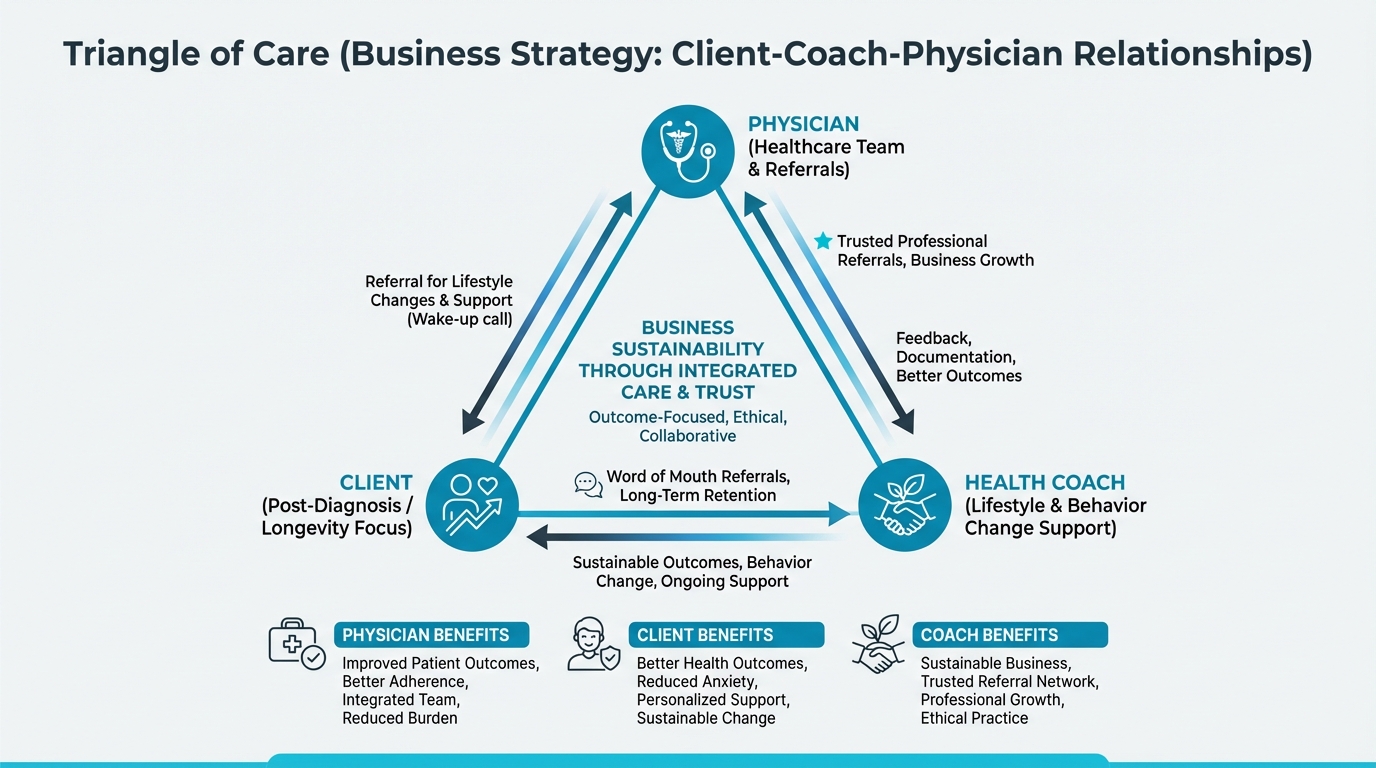
Figure: Client-Coach-Physician relationships
The coaches who succeed long-term are the ones who focus on what matters: helping clients achieve real, lasting health improvements. When that happens, everything else follows.
Study Guide Questions
Here are some questions that can help you think through the material and prepare for the chapter exam. They're optional, but we recommend you try answering at least a few as part of your active learning process.
-
How would you describe the difference between longevity coaching and general health coaching to a potential client?
-
Why is a 3-month minimum commitment often recommended for coaching packages? How does this align with what we know about behavior change?
-
What are three strategies for building trust with physicians who might refer clients to you?
-
What should you include in your client agreement to protect both yourself and your clients regarding scope of practice?
-
Why is client retention often more valuable than client acquisition in a longevity coaching practice?
-
What are signs that a coach might be heading toward burnout, and what protective factors can help?
[CHONK: Works Cited]
Deep Dives
Want to go deeper? These supplemental articles explore key topics from this chapter in more detail.
- Business Models for Coaches: Detailed pricing strategies by market segment
References
-
Coherent Market Insights. Health Coach Market Size to Worth $28.12 billion, Globally, by 2031. GlobeNewswire; 2024. https://www.globenewswire.com/news-release/2024/09/09/2943006/0/en/Health-Coach-Market-Size-to-worth-28-12-billion-Globally-by-2031
-
Precedence Research. Health Coach Market Size, Share, and Trends 2024 to 2034. 2024. https://www.precedenceresearch.com/health-coach-market
-
Bleck J, Smith K, Mansouri J, Early C. Exploring the Link Between Demographic, Employment, and Coaching Characteristics With Financial Earning Among Health and Wellness Coaches. American Journal of Lifestyle Medicine. 2023;19(6):870-887. doi:10.1177/15598276231218939
-
Zippia. Health Coach Demographics and Statistics in the US. 2025. https://www.zippia.com/health-coach-jobs/demographics/
-
Reich K, Butterworth SW, Coday M, Bailey JE. Integrating Lay Health Coaches Into Primary Care: Acceptability, Credibility, and Effectiveness From the Provider Perspective. Cureus. 2022. doi:10.7759/cureus.25457
-
Denneson LM, Purcell N, McGrath SL, Abadjian LR, Becker WC, Seal KH. Integration of Health Coaches in a Whole Health Team Model of Chronic Pain Care: a Qualitative Study. Journal of General Internal Medicine. 2023;38(16):3574-3580. doi:10.1007/s11606-023-08317-x
-
Health Coaching: Help Patients Take Charge of Their Health. Available from: https://edhub.ama-assn.org/steps-forward/module/2827438
-
Nhim K, Khan T, Gruss S, Wozniak G, Kirley K, Schumacher P, et al. Facilitators to referrals to CDC's National Diabetes Prevention Program in primary care practices and pharmacies: DocStyles 2016–2017. Preventive Medicine. 2021;149:106614. doi:10.1016/j.ypmed.2021.106614
-
Bouraoui A, Newman P, Fisher C, Shah A, Burman R, Mavrommatis S, et al. Feasibility and acceptability of multidisciplinary team training in health coaching: Case study in adolescent rheumatology. Future Healthcare Journal. 2024;11(1):100013. doi:10.1016/j.fhj.2024.100013
-
Aguilar M.. Health coaches are completely unregulated. STAT News; 2023. https://www.statnews.com/2023/05/09/health-care-coaches-regulation/
-
Cohen MH. Health Coaching Compliance: Legal Strategies for Success. Cohen Healthcare Law Group; 2025. https://cohenhealthcarelaw.com/legal-and-compliance-strategies-for-health-coaching-businesses/
-
Precision Nutrition. Do nutrition and health coaches need insurance?. 2023. https://www.precisionnutrition.com/do-health-coaches-need-insurance
-
Functional Medicine Coaching Academy. What Health Coaches Need to Know About Liability Insurance. 2023. https://functionalmedicinecoaching.org/blog/liability-insurance/