Unit 1: Foundations of Longevity Coaching
Chapter 1.3: Deep Health & The Longevity Mindset
[CHONK: 1-minute summary]
What you'll learn in this chapter:
- How all six Deep Health dimensions, not just physical, affect how long and how well people live
- Why your client's beliefs about aging can add (or subtract) years from their life
- How purpose and meaning predict survival as strongly as many physical risk factors
- Practical strategies for coaching the whole person, not just biomarkers
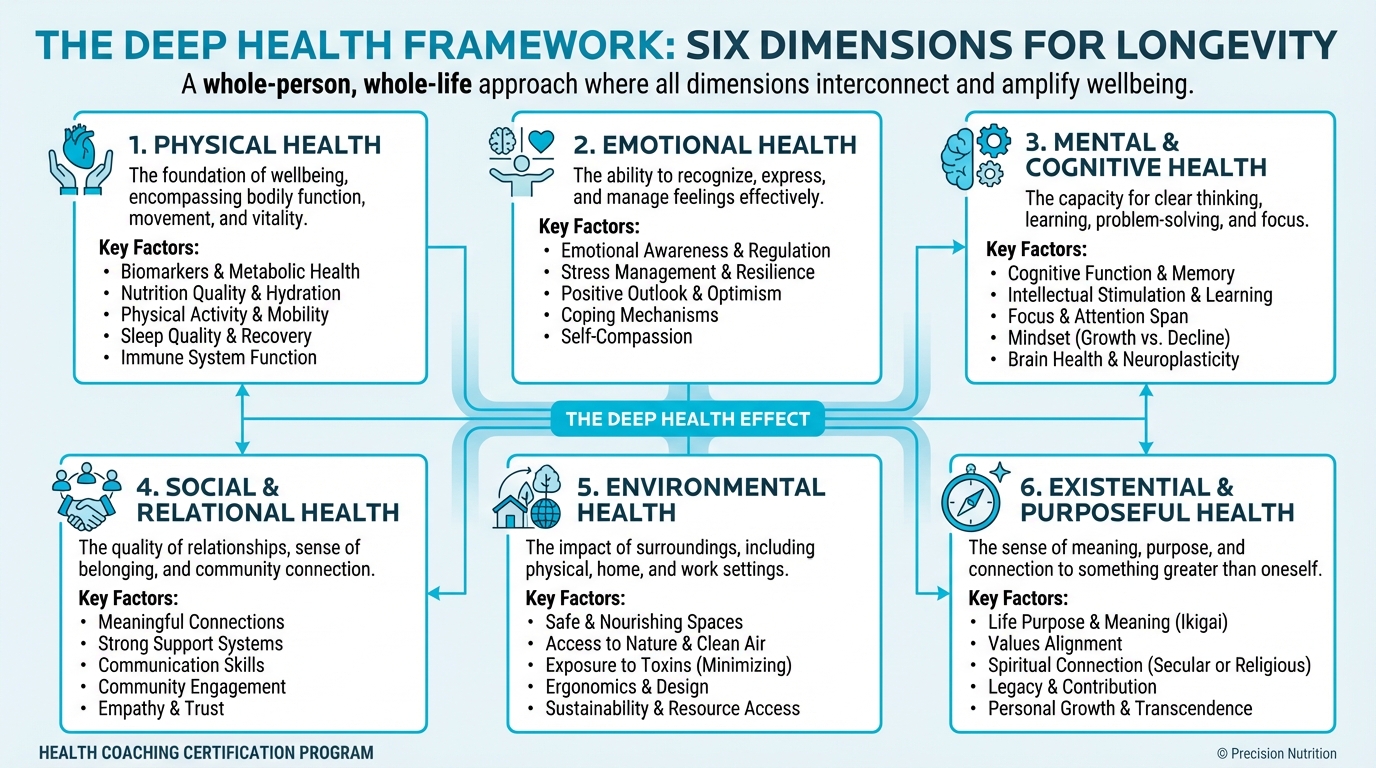
Figure: Each dimension with key factors
The big idea: Longevity isn't just about exercise and nutrition. People with positive beliefs about aging live 7.5 years longer. People with a strong sense of purpose have 50% lower mortality risk. As a longevity coach, you need to coach the whole person—all six dimensions of Deep Health—not just their physical health.
Introduction
In Chapter 1.1, we introduced Deep Health as Precision Nutrition's whole-person approach. In Chapter 1.2, we covered the biology: mitochondria, inflammation, autophagy. Now we're bringing it together: how do all six dimensions of Deep Health affect longevity? And here's the part that surprises most coaches: how do your client's beliefs about aging affect their actual biology?
Consider this finding: older adults with positive self-perceptions of aging lived an average of 7.5 years longer than those with negative perceptions, even after controlling for health status, socioeconomic factors, and loneliness.¹ That's not a rounding error. That's the difference between meeting your great-grandchildren and not.
Or this: in large Japanese studies, people without a sense of purpose had 50% higher mortality over seven years.² Purpose isn't a nice-to-have. It's a survival factor.
These findings appear consistently across decades of research. Psychological factors—mindset, purpose, optimism, social connection—predict longevity as strongly as many physical risk factors. And they do this partly by affecting biology: stress hormones, inflammation, immune function, even epigenetic aging.
What does this mean for coaching? You can't just focus on physical health. A perfect exercise program won't overcome a client who believes they're "too old" or has no reason to get out of bed. You need to coach the whole person.
This chapter teaches you how.
[CHONK: The Deep Health Framework - Six Dimensions Applied to Longevity]
The Deep Health Framework — Six Dimensions for Longevity
Deep Health recognizes that wellbeing emerges from six interdependent dimensions. Each one influences how people age, not just lifespan, but quality of life throughout.
Here's the quick reference:
| Dimension | What It Is | Longevity Impact | What Coaches Can Influence |
|---|---|---|---|
| Physical | Body function, performance, biomarkers | Foundation for all other dimensions | Exercise, nutrition, sleep, recovery |
| Emotional | Feeling, regulating, expressing emotions | Optimism linked to 11-15% longer life³ | Stress management, resilience building |
| Mental | Thinking, learning, cognitive function | Growth mindset protects against decline | Lifelong learning, cognitive challenge |
| Social | Relationships, connection, belonging | Strong ties = 50% better survival odds⁴ | Relationship quality, community building |
| Environmental | Physical surroundings, access, safety | Explains ~17% of mortality variation⁵ | Home environment, toxin reduction |
| Existential | Purpose, meaning, identity | Purpose = ~50% lower mortality risk² | Exploring "why," connecting health to values |
Let's look at each dimension through a coaching lens.
Physical Health
Physical health is the dimension most people think of when considering longevity: biomarkers, fitness, body composition, absence of disease.
The research: Regular physical activity, adequate nutrition (especially protein, vitamin D, calcium), and quality sleep are central to healthy aging.⁶ Poor sleep in older adults links to cognitive decline, disability, and higher mortality.
The coaching angle: Physical health is your foundation, but it's not sufficient alone. Perfect biomarkers don't guarantee a thriving life if other dimensions suffer. And here's what experienced coaches know: physical health problems often have roots in other dimensions: stress eating (emotional), no one to exercise with (social), no reason to stay healthy (existential).
What to focus on:
- Movement that includes strength, cardio, and mobility
- Nutrition that prevents age-related deficiencies
- Sleep quality (7-9 hours for most adults)
- Recovery that matches training load
Emotional Health
Emotional health is the ability to feel a full range of emotions while maintaining overall balance. It includes recognizing, regulating, and expressing emotions appropriately, plus resilience when life gets hard.
The research: Chronic stress and poor emotion regulation accelerate biological aging, increase inflammation, and raise mortality risk. But here's what's interesting: one study found that chronic stress predicted higher cardiometabolic risk only among adults with low emotion regulation ability.⁷ Those with strong regulation skills were protected. Emotional resilience isn't just "nice". It's biologically protective.
Optimism shows up consistently. Higher optimism associates with 11-15% longer lifespan and 50-70% higher odds of reaching 85.³ These effects persist even after adjusting for health behaviors, suggesting optimism does more than just encourage healthier habits.
The coaching angle: You're not a therapist, but you can help clients build emotional skills. When a client keeps sabotaging their nutrition plan, look for what's driving it emotionally. When stress derails sleep, address the stress, not just the sleep hygiene.
What to focus on:
- Stress management techniques that actually fit their life
- Building resilience through problem-solving and self-compassion
- Helping clients notice patterns between emotions and behaviors
- Knowing when to refer to mental health professionals
Mental/Cognitive Health
Mental health here means cognitive function, thinking, learning, remembering, problem-solving. It also includes mindset: the beliefs people hold about their own abilities.
The research: Age-related cognitive decline isn't inevitable. The brain retains adaptive capacity throughout life.⁸ Lifelong learning associates with better cognitive outcomes.⁹ And mindset matters. We'll cover this extensively in the next section, but the short version: people who believe abilities can be developed (growth mindset) have better cognitive outcomes than those who believe abilities are fixed.
The coaching angle: Cognitive health affects everything else. Clients need clear thinking to make health decisions, remember coaching guidance, and solve problems when plans go sideways. And mindset shapes whether they even try. A client who believes "I'm too old to learn" won't attempt new behaviors.
What to focus on:
- Encouraging new learning (skills, hobbies, languages)
- Physical activity (which supports brain health through BDNF and blood flow)
- Addressing fixed beliefs about aging and ability
- Social engagement (learning with others provides cognitive + social benefits)
Social/Relational Health
Social health is about connecting with others: authentic relationships, belonging, being valued and supported.
The research: A major meta-analysis found that stronger social relationships associated with about 50% greater odds of survival.⁴ That effect is comparable to quitting smoking. However, nuance matters: recent research suggests relationship quality matters more than quantity.¹⁰ High-conflict relationships can actually increase mortality risk. It's not about being surrounded by people. It's about having a few good ones.
The coaching angle: Social connection is both a longevity factor and a tool for achieving other health goals. Clients who join exercise groups stick with programs longer. Clients who cook with family eat better. Social support isn't just the outcome. It's the vehicle.
When clients are isolated, this becomes a coaching priority. Sometimes helping someone join a walking group matters more than perfecting their macros.
What to focus on:
- Assessing relationship quality, not just quantity
- Building on existing connections rather than forcing new ones
- Using social activities as vehicles for health goals (group fitness, cooking with friends)
- Recognizing when loneliness is the root issue
Environmental Health
Environmental health is about physical surroundings: safety, access to resources, clean air and water, exposure to nature.
The research: A large UK study found that environmental and lifestyle factors explained about 17% of disease-related mortality risk, compared to only about 2% from genetics.⁵ Translation: where and how you live matters far more than your DNA for most people.
Air pollution alone accounts for approximately 2.9 million global deaths per year.¹¹ Access to green space, walkable neighborhoods, and age-friendly housing all predict better health outcomes for older adults.¹²
The coaching angle: Environment is often overlooked because it feels "out of scope." But you can't out-exercise a toxic environment. If a client lives somewhere unsafe to walk, your walking prescription won't work. If their kitchen makes healthy cooking impossible, nutrition advice falls flat.
What to focus on:
- Identifying environmental barriers to health behaviors
- Improving what's controllable (sleep environment, home organization, air quality)
- Helping clients access resources when needed
- Recognizing when environment is the limiting factor
Existential/Purposeful Health
Existential health is about having a deeper "why": a sense that your life has meaning and direction.
The research: Purpose is one of the strongest longevity predictors. In Japanese cohort studies, absence of ikigai (roughly "reason for being") associated with 50% higher all-cause mortality and 60% higher cardiovascular mortality.² U.S. studies confirm this: the lowest purpose group had about 2.4 times higher mortality than the highest purpose group.¹³
Purpose even affects biological aging. Greater purpose associates with reduced epigenetic age acceleration across multiple biological age clocks.¹⁴
The coaching angle: This dimension often gets skipped because it feels "soft" or outside coaching scope. But purpose is what makes everything else make sense. A client with strong purpose has motivation to maintain health behaviors. A client without purpose asks "why bother?"
You don't prescribe purpose. You help clients discover and reconnect with it.
What to focus on:
- Exploring what matters to clients beyond health metrics
- Connecting health behaviors to deeper values ("Why does being strong matter to you?")
- Helping clients find meaning in daily activities
- Supporting purpose evolution as clients age
[CHONK: How Dimensions Interconnect - The Deep Health Effect]
How Dimensions Interconnect
These six dimensions don't work in isolation; they form feedback loops, so improvements in one dimension tend to ripple into others.
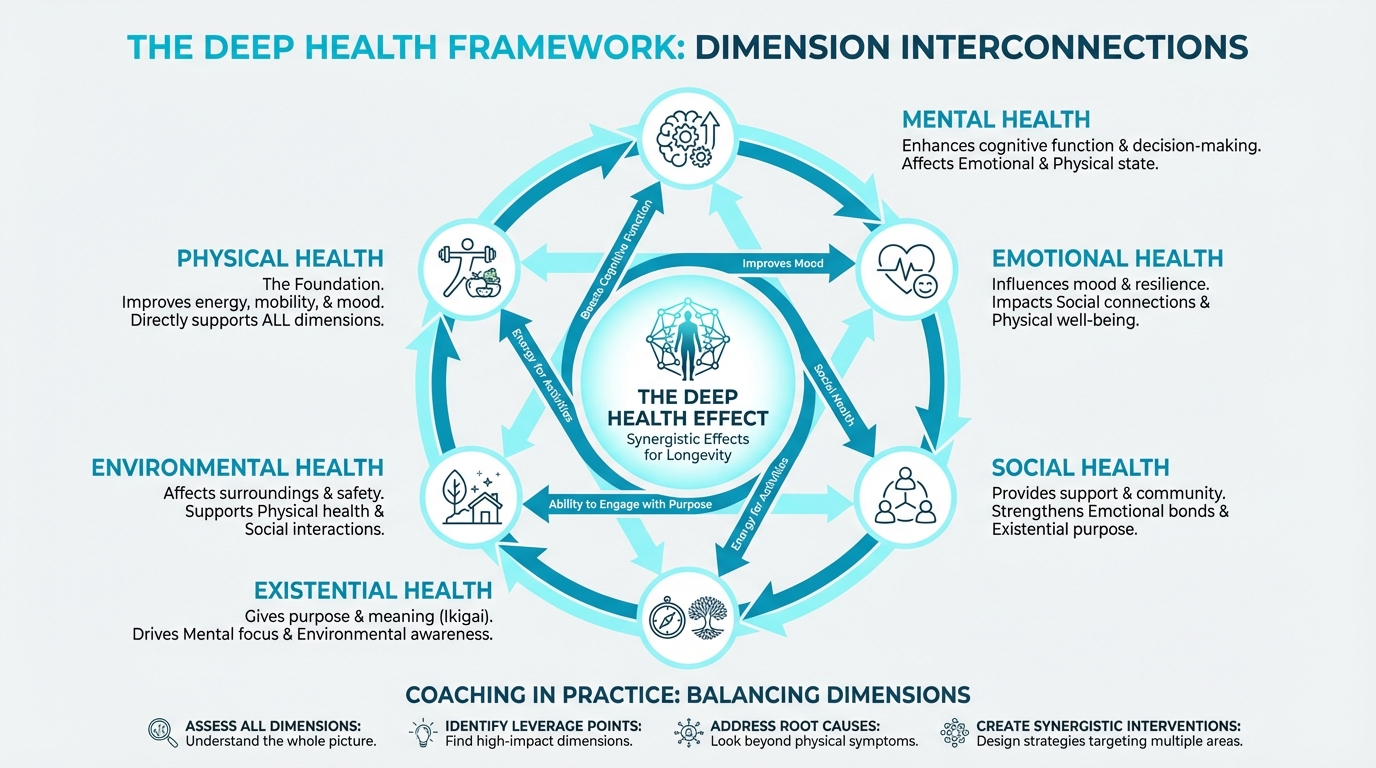
Figure: How dimensions influence each other
Positive cascades:
- Better physical health → improved mood → clearer thinking → more energy for relationships → greater sense of capability
- Stronger social connections → reduced stress → better sleep → more motivation for self-care → renewed purpose
- Clear sense of purpose → motivation for health behaviors → improved resilience → stronger relationships
Negative cascades:
- Chronic stress → poor sleep → impaired thinking → strained relationships → diminished sense of meaning
- Social isolation → less motivation → declining physical health → worsening mood → further withdrawal
What this means for coaching:
When you improve one dimension, expect benefits elsewhere, and when problems persist despite intervention, look for root causes in other dimensions. A client who can't stick to nutrition changes might have an emotional eating pattern (emotional), no support at home (social), or no compelling reason to be healthy (existential).
The practical implication: assess all dimensions, even when the presenting goal is physical. Find leverage points: which dimension, if improved, would have the biggest positive ripple effect?
| For DIY Learners |
|---|
| Applying this to yourself: Grab a piece of paper and rate yourself 1-10 on each Deep Health dimension: Physical, Emotional, Mental, Social, Environmental, Existential. Now look at your ratings. Which dimension is your strongest? Which feels like the biggest drag? Here's the key question: if you could only improve ONE dimension, which would create the biggest positive ripple effect across all the others? That's your leverage point. Start there. |
[CHONK: The Longevity Mindset - Growth vs. Decline]
The Longevity Mindset — Growth vs. Decline
Your client's beliefs about aging matter. Not just for how they feel, but for how long they live and how their cells age.
What We Mean by Growth vs. Decline Mindset
Decline mindset is the belief that aging means inevitable deterioration. People with this mindset:
- Avoid challenges that might reveal limitations
- Give up quickly when facing age-related difficulties
- See aging as a process of loss
- Believe they can't learn new things "at their age"
Growth mindset is the belief that abilities can be developed and aging can include growth. People with this mindset:
- See challenges as opportunities to adapt
- Persist through difficulties
- View aging as having both challenges and opportunities
- Believe they can continue learning and improving
These aren't just attitudes. They affect behavior, biology, and survival.
The 7.5 Years Finding
In a landmark study, researchers followed older adults for 23 years.¹ Those with more positive self-perceptions of aging lived an average of 7.5 years longer than those with negative perceptions, even after controlling for age, sex, baseline health, socioeconomic status, and loneliness.
A 2023 meta-analysis confirmed these findings across multiple studies.¹⁵ Positive age beliefs and "feeling younger" consistently predict better health and lower mortality.
How Mindset Affects Biology
This isn't just psychology. Mindset affects measurable biological processes:
Stress response: Positive mindsets reduce cortisol output and improve HPA-axis function (the system controlling stress response).¹⁶
Inflammation: Adaptive emotion regulation links to lower inflammatory markers and reduced immune aging.
Health behaviors: Growth mindsets encourage healthier choices: more exercise, better nutrition, greater use of preventive care.
Epigenetic aging: Feeling older than your chronological age associates with accelerated epigenetic aging. Purpose in life associates with reduced epigenetic age acceleration.¹⁴
Optimism and Resilience
Related to growth mindset, optimism and resilience also predict longevity.
Optimism: Higher optimism associates with 11-15% longer lifespan and 50-70% higher odds of reaching age 85.³ Optimism predicts lower mortality even after adjusting for health behaviors, suggesting it works through more than just encouraging healthy habits.
Resilience: Higher resilience associates with 20-38% lower all-cause mortality, with clear dose-response relationships.¹⁷ Even people with genetic predisposition to shorter survival can offset that risk with high physical resilience.¹⁸
Coaching for Growth Mindset
The encouraging news: mindsets can be changed. Research shows growth mindset interventions improve beliefs, health behaviors, and cognitive outcomes in older adults.¹⁹
Strategies:
-
Surface fixed beliefs: Listen for language like "I'm too old to..." or "At my age, you can't..." These signal decline mindset.
-
Challenge gently: Don't argue. Get curious. "What makes you think that? What would it mean if that weren't true?"
-
Provide counter-evidence: Share examples of people thriving at older ages. Research showing adaptation is possible.
-
Create success experiences: Small wins build self-efficacy. Help clients prove to themselves they can do more than they thought.
-
Reframe setbacks: When things don't go perfectly, frame it as learning rather than confirmation of decline.
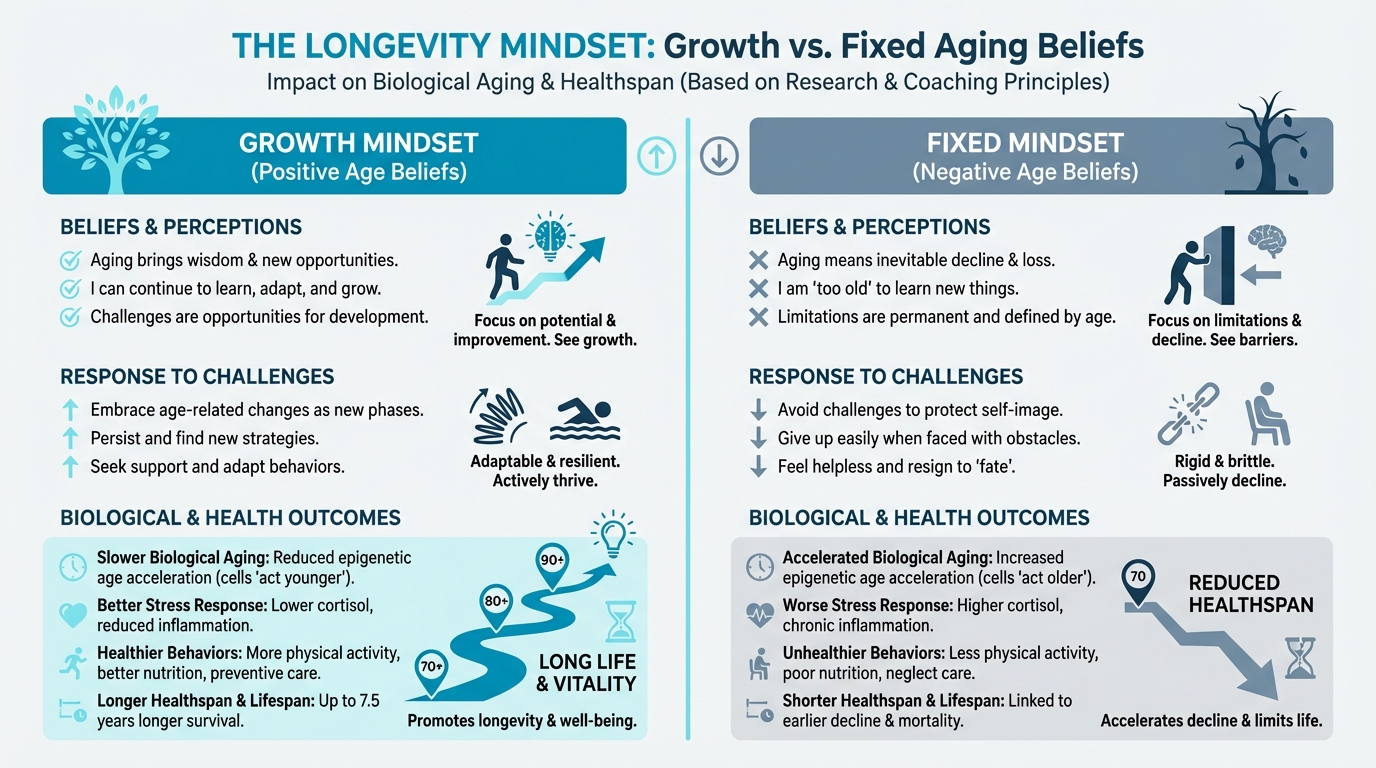
Figure: Side-by-side for aging beliefs
[CHONK: Coaching in Practice - Shifting Mindset]
Coaching in Practice: "I'm Too Old for This"
The scenario: Robert, 67, wants to start strength training but keeps putting it off. "I should have done this 20 years ago. It's too late now. I'll just hurt myself."
What NOT to do:
❌ "You're never too old! Research shows older adults can build muscle at any age!"
Why it doesn't work: You've dismissed his concern without understanding it. He'll nod and keep not starting.
What TO do:
✅ Get curious about the belief, then offer a different frame.
Sample dialogue:
Coach: "Tell me more about that. What specifically worries you about starting now?"
Robert: "I've seen guys my age get hurt in the gym. And honestly, what's the point? I'm not going to look like I did at 40."
Coach: "Makes sense you'd be cautious. And you're right, the goal isn't looking 40 again. What would being stronger actually let you do? What do you want to be able to do in 5 years, 10 years?"
Robert: "Keep up with my grandkids. Stay independent. Not be one of those guys who can't get off the floor."
Coach: "Those are exactly the things strength training protects. Here's what I know from the research: people who start strength training in their 60s and 70s see significant gains. We're not talking about bodybuilding. We're talking about being able to get off the floor, carry groceries, play with grandkids."
Robert: "I guess I assumed it was too late."
Coach: "What if we started with exercises you already know are safe? Bodyweight stuff, nothing fancy. See how you respond. You can always add more later. But you can't find out what's possible without trying."
Key takeaway: Don't dismiss the concern. Explore it, then redirect to what matters to them.
[CHONK: Purpose and Longevity - The Ikigai Effect]
Purpose and Longevity — What Gets You Out of Bed
Having a reason to live, a sense that your life matters, is one of the strongest predictors of longevity. Research from Japan, the U.S., and Blue Zones consistently shows that purpose protects against mortality, supports biological health, and improves quality of life.
What We Mean by Purpose
Purpose is a sense that your life has meaning and direction, that you're part of something beyond just yourself. It doesn't require a grand mission. It can be found in relationships, work, hobbies, service, or simply in daily routines that matter.
Ikigai is the Japanese concept roughly translated as "reason for being." In Japan, it's an everyday orientation, not abstract philosophy, but a practical sense of what makes life worth living.
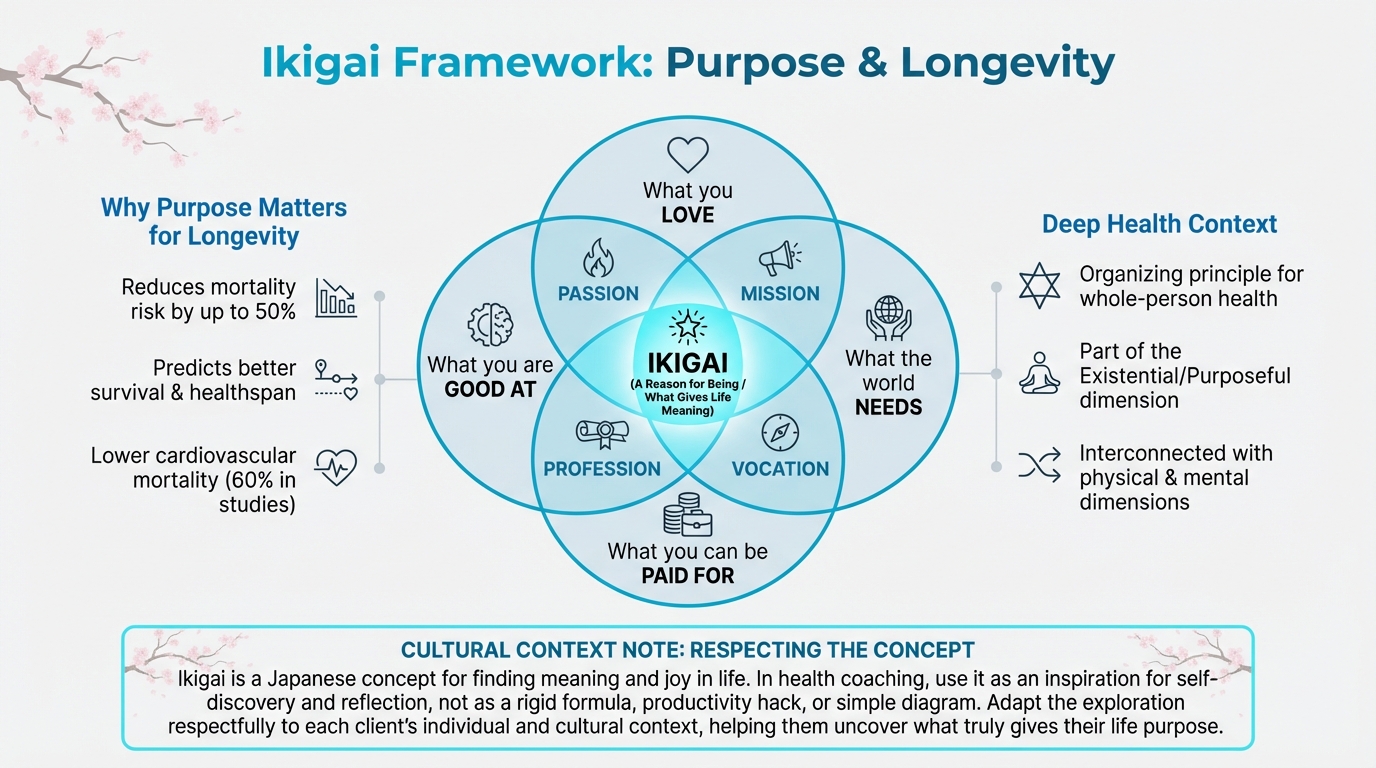
Figure: Four circles with cultural context note
A note on cultural respect: When using ikigai concepts in coaching, don't reduce it to a productivity diagram or treat it as a hack. Use it as inspiration for helping clients explore what gives their life meaning, adapted to their own context.
The Evidence
The research is extensive and consistent across cultures.
Japanese studies: The Ohsaki Study found absence of ikigai associated with 50% higher all-cause mortality and 60% higher cardiovascular mortality over 7 years.² The Japan Collaborative Cohort Study found men with ikigai had 15% lower mortality, women had 7% lower.²⁰
U.S. studies: A 2019 analysis found the lowest purpose group had about 2.4 times higher mortality risk than the highest purpose group, even after extensive statistical adjustment.¹³ Purpose remained a significant predictor even when modeled alongside life satisfaction and self-rated health.
Blue Zones: In regions where people live exceptionally long, healthy lives, purpose is consistently present.²¹ Blue Zones researcher Dan Buettner identifies "knowing your why" as one of the "Power 9" principles shared by long-lived populations.
How Purpose Affects Biology
Purpose works through multiple pathways:
-
Health behaviors: People with purpose engage in healthier choices—exercise, nutrition, preventive care—because they have reasons to stay healthy.
-
Stress buffering: Purpose provides resilience against adversity. When bad things happen, purpose helps people cope.
-
Biological aging: Greater purpose associates with reduced epigenetic age acceleration.¹⁴ Women with ikigai have higher HDL-cholesterol, suggesting cardiometabolic benefits.²²
Coaching for Purpose
You don't prescribe purpose. You help clients discover and reconnect with it.
Questions that help:
- "What gets you out of bed in the morning?"
- "When do you feel most alive?"
- "What would you want people to say about you at your 90th birthday?"
- "Who depends on you, and how does your health affect them?"
Connecting purpose to health:
- "How does being healthy support what matters most to you?"
- "What would you be able to do if you had more energy?"
- "What's the real reason you want to lose weight/get stronger/sleep better?"
Finding meaning in daily activities:
Purpose doesn't have to be grand. Help clients find it in:
- Relationships (being present for family)
- Work (contributing, helping others)
- Hobbies (creating, learning, mastering)
- Service (volunteering, community)
- Daily routines (caring for others, maintaining a home)
[CHONK: Coaching in Practice - Discovering Purpose]
Coaching in Practice: "I Don't Know What I'm Doing This For"
The scenario: Angela, 63, retired eight months ago after 30 years as a nurse. She came to coaching because she'd gained weight and felt "flat." "I used to know who I was. Now I'm just... existing."
What NOT to do:
❌ "Have you thought about volunteering? You could use your nursing skills at a free clinic!"
Why it doesn't work: You've jumped to solutions without understanding the problem. She's grieving an identity, not looking for a task.
What TO do:
✅ Explore what she's lost, then help her find what might come next.
Sample dialogue:
Coach: "Tell me about that. What did nursing give you that you're missing now?"
Angela: "Purpose. I knew I mattered. People needed me. Every day had meaning."
Coach: "That's a significant loss. Retirement doesn't just take away a job. It takes away an identity."
Angela: "Exactly. And everyone acts like I should be thrilled. 'You've earned this!' But I feel like I lost myself."
Coach: "So the question isn't really 'what should I do with my time.' It's 'who am I now, and what gives my life meaning?'"
Angela: "Yes. That's exactly it."
Coach: "Let's spend some time there. What parts of nursing gave you the most satisfaction? Not the tasks, the deeper stuff."
Angela: "Helping people in scary moments. Making them feel seen. Teaching new nurses."
Coach: "Those are capacities you still have. The question is where else they might fit. What if we explored that, not rushing to an answer, but genuinely exploring what 'mattering' could look like in this chapter of life?"
Key takeaway: Purpose exploration takes time. Don't rush to solutions. Create space for clients to grieve what they've lost before moving toward what's next.
[CHONK: Integrating Deep Health into Coaching]
Putting It All Together — Coaching Across Dimensions
Now let's make this practical. How do you actually use Deep Health in your coaching?
The Deep Health Assessment
Before coaching across dimensions, you need to understand where your client is in each one.
What to assess for each dimension:
- Current state (how is this dimension right now?)
- Challenges (what's getting in the way?)
- Strengths (what's already working?)
- Interconnections (how does this affect other dimensions?)
How to assess:
- Conversation and open-ended questions
- Structured assessment tools (covered in Chapter 1.4)
- Observation (what clients mention vs. avoid)
- Client self-ratings with explanations
What to look for:
- Imbalances between dimensions
- Leverage points (where improvement would ripple to other areas)
- Root causes hiding in non-obvious dimensions
- Opportunities for synergistic interventions
Finding Leverage Points
Not all dimensions are equally important for every client. The key is finding where intervention will have the biggest positive effect.
Examples:
A client struggling with nutrition consistency:
- Surface issue: Can't stick to eating plan (physical)
- Possible root cause: Stress eating after work conflicts (emotional)
- Or: No one at home supports healthy eating (social)
- Or: Doesn't really believe health matters anymore (existential)
A client who can't get motivated to exercise:
- Surface issue: Skipping workouts (physical)
- Possible root cause: Depression or burnout (emotional)
- Or: No workout buddies, exercise feels lonely (social)
- Or: No compelling reason to be fit (existential)
The principle: When physical interventions aren't working, look to other dimensions for the real barrier.
Synergistic Interventions
Design interventions that hit multiple dimensions simultaneously:
| Intervention | Dimensions Addressed |
|---|---|
| Exercise with friends | Physical + Social |
| Cooking healthy meals for family | Physical + Social + Existential |
| Mindful walking in nature | Physical + Emotional + Environmental |
| Volunteering at a community garden | Physical + Social + Existential + Environmental |
| Learning a new sport | Physical + Mental + Social |
The more dimensions an intervention touches, the more likely it is to stick and create positive cascades.
[CHONK: Coaching in Practice - Balancing Dimensions]
Coaching in Practice: "My Numbers Are Bad"
The scenario: David, 56, came to coaching after a wake-up call from his doctor: high blood pressure, prediabetic A1C. His goal: "Get my numbers down." A Deep Health assessment revealed:
- Physical: Sedentary, poor nutrition, 6 hours sleep
- Emotional: High stress, difficulty unwinding after work
- Mental: Sharp but no hobbies or learning outside work
- Social: Few friends, marriage is "fine but distant"
- Environmental: Long commute, no time for food prep
- Existential: Work is his identity, but he's burning out
What NOT to do:
❌ Create a detailed nutrition and exercise plan without addressing other dimensions.
Why it doesn't work: His physical problems have roots in stress (emotional), work demands (environmental), and lack of purpose beyond work (existential). A physical-only plan will fail.
What TO do:
✅ Address the leverage points, not just the surface symptoms.
Sample approach:
Coach: "I hear that the numbers are the immediate concern. But I'm curious: what's driving the lifestyle that produced those numbers?"
David: "Work, mostly. I'm there 12 hours a day. By the time I get home, I'm too tired to cook or exercise."
Coach: "So the physical stuff is downstream from work stress and schedule. If we only addressed nutrition and exercise without addressing that, how likely is it to stick?"
David: "Not very, honestly. I've tried that before."
Coach: "What if we worked on two tracks? Some immediate physical changes that are realistic given your schedule, nothing that requires time you don't have. And also looked at the work situation: what's keeping you there 12 hours, and is any of that changeable?"
David: "I'm not sure the work part is changeable."
Coach: "Maybe, maybe not. But let's at least understand it before we decide. What would it mean for your health if you stayed on this trajectory for another 5 years?"
Key takeaway: Physical symptoms often have roots in other dimensions. Address the system, not just the symptom.
Study Guide Questions
-
Name the six Deep Health dimensions and give one example of how each affects longevity.
-
What did the "7.5 years" study find, and what does it mean for coaching?
-
Explain the difference between growth and decline mindset about aging. How does mindset affect biology?
-
What is ikigai, and how does purpose predict mortality?
-
What's a "leverage point" in Deep Health coaching? Give an example.
-
A client says "I'm too old to start exercising." How would you respond using growth mindset coaching?
-
How would you help a recently retired client who's lost their sense of purpose?
-
What's the "Deep Health Effect"? Why does improving one dimension often improve others?
-
Give an example of a synergistic intervention that addresses multiple Deep Health dimensions.
-
When should you look beyond physical health to find root causes?
Self-reflection questions:
-
Rate yourself 1-10 on each Deep Health dimension. Where are you thriving? Where is there room for growth?
-
What's your own mindset about aging? Do you notice any "decline mindset" beliefs that might be limiting you?
[CHONK: Works Cited]
Deep Dives
Want to go deeper? These supplemental articles explore key topics from this chapter in more detail.
- The Blue Zones: What We Can Learn: Social and existential factors in longevity
- Research Review: Mindset & Biological Aging: Studies linking beliefs to biomarkers
References
-
Levy BR, Slade MD, Kunkel SR, Kasl SV. Longevity increased by positive self-perceptions of aging. Journal of Personality and Social Psychology. 2002;83(2):261-270. doi:10.1037/0022-3514.83.2.261
-
Sone T, Nakaya N, Ohmori K, et al. Sense of Life Worth Living (Ikigai) and Mortality in Japan: Ohsaki Study. Psychosomatic Medicine. 2008;70(6):709-715. doi:10.1097/psy.0b013e31817e7e64
-
Lee LO, James P, Zevon ES, et al. Optimism is associated with exceptional longevity in 2 epidemiologic cohorts of men and women. Proceedings of the National Academy of Sciences. 2019;116(37):18357-18362. doi:10.1073/pnas.1900712116
-
Holt-Lunstad J, Smith TB, Layton JB. Social Relationships and Mortality Risk: A Meta-analytic Review. PLoS Medicine. 2010;7(7):e1000316. doi:10.1371/journal.pmed.1000316
-
Time Magazine. Want to live long? Lifestyle matters more than genes. 2025. https://time.com/7261172/genes-vs-lifestyle-longevity-study/
-
Hung S, Cheng Y, Wu C, Su C. Examining Physical Wellness as the Fundamental Element for Achieving Holistic Well-Being in Older Persons. Journal of Multidisciplinary Healthcare. 2023;16:1889-1904. doi:10.2147/jmdh.s419306
-
Roy B, Riley C, Sinha R. Emotion regulation moderates the association between chronic stress and cardiovascular disease risk in humans. Stress. 2018;21(6):548-555. doi:10.1080/10253890.2018.1490724
-
Navakkode S, Kennedy BK. Neural ageing and synaptic plasticity: prioritizing brain health in healthy longevity. Frontiers in Aging Neuroscience. 2024;16. doi:10.3389/fnagi.2024.1428244
-
Wang Y, et al. Later-life learning and cognitive outcomes in older U.S. adults. 2025.
-
Bookwala J, Gaugler JE. Relationship quality and 5-year mortality risk. Social Science & Medicine. 2020.
-
Pandics T, Major D, Fazekas-Pongor V, et al. Exposome and unhealthy aging: environmental drivers from air pollution to occupational exposures. GeroScience. 2023;45(6):3381-3408. doi:10.1007/s11357-023-00913-3
-
Davern M, et al. Access to public open space and health outcomes for older adults. 2020.
-
Alimujiang A, Wiensch A, Boss J, et al. Association Between Life Purpose and Mortality Among US Adults Older Than 50 Years. JAMA Network Open. 2019;2(5):e194270. doi:10.1001/jamanetworkopen.2019.4270
-
Kim ES, et al. Purpose in life and epigenetic age acceleration. 2023.
-
Westerhof GJ, et al. Subjective aging and health outcomes: meta-analysis. 2023.
-
Richer M, Grenier S, Lupien S, Plusquellec P. Increasing stress resilience in older adults through a 6-week prevention program. Frontiers in Psychology. 2025;15. doi:10.3389/fpsyg.2024.1499609
-
Zhang Q, Li S, Wu Y. Resilience and mortality: systematic review. Innovation in Aging. 2024;8(3). doi:10.1093/geroni/igae015
-
Stark L, Triolo F, Vetrano DL, et al. Physical Resilience May Offset Mortality Risks Associated With Genetic Predisposition to Shorter Survival. The Journals of Gerontology, Series A. 2025;80(7). doi:10.1093/gerona/glaf101
-
Sheffler P, Kürüm E, Sheen AM, et al. Growth Mindset Predicts Cognitive Gains in an Older Adult Multi-Skill Learning Intervention. International Journal of Aging and Human Development. 2022;96(4):501-526. doi:10.1177/00914150221106095
-
Tanno K, Sakata K, Ohsawa M, et al. Associations of ikigai as a positive psychological factor with all-cause mortality. Journal of Psychosomatic Research. 2009;67(1):67-75. doi:10.1016/j.jpsychores.2008.10.018
-
Buettner D. Lessons From the Blue Zones: There is No Silver Bullet (or Magic Pill) for a Long, Healthy Life. American Journal of Lifestyle Medicine. 2025;19(7):1052-1062. doi:10.1177/15598276251334310
-
Ikeda A, et al. Ikigai and cardiometabolic biomarkers in Japanese women. 2024.
Chapter 1.3 complete. Proceed to Chapter 1.4: Assessment and Biomarkers.