Unit 1: Foundations of Longevity Coaching
Chapter 1.1: Introduction to Longevity Coaching
[CHONK: 1-minute summary]
What you'll learn in this chapter:
- What longevity coaching is (and what it's not)
- Why longevity coaching matters now
- How Precision Nutrition's approach differs from hype-driven methods
- What to expect from this certification
The big idea: Longevity coaching isn't about living forever. It's about helping people maximize their healthspan—the years they live in good health—so they can thrive at every age.
Introduction
Welcome to Longevity Coaching.
You're about to learn something that matters. This certification will teach you how to help people live well, not just longer, at every stage of life. Whether you're here because you're passionate about aging research, because you've watched someone you love struggle with preventable decline, or simply because you want to help people thrive, you're in the right place. (And we're glad you're here.)
Before we dive in, let's explore what longevity coaching actually is.
Longevity coaching isn't about promising immortality or selling expensive supplements. It's not about "biohacking" your way to 150 or following a rigid protocol that ignores your client's actual life. And it's definitely not about medical treatment—that's for doctors.
Longevity coaching is about helping people maximize their healthspan, the years they live in good health, free from disease and disability. It's about translating complex longevity science into practical, sustainable behavior change that fits into real lives.
The world needs this right now. By 2030, 1.4 billion people will be 60 or older. In the United States, 93 percent of adults 65 and older have at least one chronic condition, and most of these conditions are preventable through lifestyle changes.¹
But here's the challenge: most people don't know how to optimize for longevity. They're bombarded with conflicting information, expensive products with weak evidence, and fear-based marketing. They need someone who can cut through the noise, evaluate the evidence, and help them make changes that actually work.
That's where you come in.
Who This Course Is For
This certification welcomes two types of learners—and you might be both.
If you're a coach (or want to become one), you'll learn how to guide clients through evidence-based longevity strategies, stay within your scope, and collaborate with healthcare providers.
If you're here for yourself—to apply these principles to your own longevity journey—you're in great company. Many of our best students take this course to become their own longevity advocate. Wherever you see "your client," feel free to read it as "yourself." The science is the same, and the strategies work whether you're coaching someone else or leading your own health.
In fact, we encourage both approaches. The most effective coaches are the ones who've walked this path themselves. Think of it as wearing two hats:
- Your "coach hat": Learning how to help others make lasting changes
- Your "client hat": Applying these principles to your own life
Throughout this course, you'll find "For DIY Learners" callout boxes that translate coaching concepts into personal application. And in Unit 4, we've included a dedicated chapter on self-practice—because the best way to understand what clients experience is to experience it yourself.
Whether you're here to build a coaching practice, optimize your own longevity, or both—let's get started.
[CHONK: What Is Longevity Coaching?]
What Is Longevity Coaching?
Longevity coaching is helping clients optimize their health behaviors to maximize healthspan and delay age-related decline.
To really understand what this means, we need to unpack a few key concepts.
Healthspan vs. Lifespan
Lifespan is straightforward: it's the total number of years you live, from birth to death.
Healthspan is trickier to define, and researchers are still working on a standardized definition. But broadly, healthspan refers to the years you live in good health, free from disease, disability, and the limitations that come with aging. If your lifespan is 90 years but you spend the last 15 years dealing with chronic pain, mobility issues, and multiple health conditions, your healthspan might be 75 years.
Here's why healthspan matters more than lifespan: living longer doesn't automatically mean living better.
Between 2000 and 2019, global life expectancy increased by about 6.3 years, but healthy life expectancy only increased by about 5.4 years.² That means people are living longer, but they're spending more of those extra years in poor health. Globally, people spend roughly 9 years at the end of life in declining health.³
Your job as a longevity coach is to help clients compress that gap. Instead of living 90 years with 15 years of decline, maybe they can live 90 years with only 8 years of decline. That's 7 more years of thriving—7 more years of being able to do the things they love, spend time with people they care about, and contribute meaningfully to their communities.
(This is what makes the work meaningful. You're not just adding years. You're adding life to years.)
What Longevity Coaching Is NOT
Let's be clear about what longevity coaching isn't. This part matters for staying in your lane.
It's not "anti-aging." Aging is natural and inevitable. You can't reverse it, stop it, or eliminate it. What you can do is optimize how you age—supporting your body's natural processes, reducing risk factors, and building resilience.
It's not biohacking for immortality. The longevity space is full of people promising to "hack" their way to 150 using expensive supplements and extreme protocols. Some of these interventions have promise (we'll discuss them honestly in this course), but most lack solid human evidence. Longevity coaching is grounded in evidence, not hype.
It's not medical treatment. You're a coach, not a doctor. You don't diagnose diseases, prescribe medications, order lab tests, or interpret medical results. You support, guide, and strategize. Medical decisions belong to licensed healthcare providers.
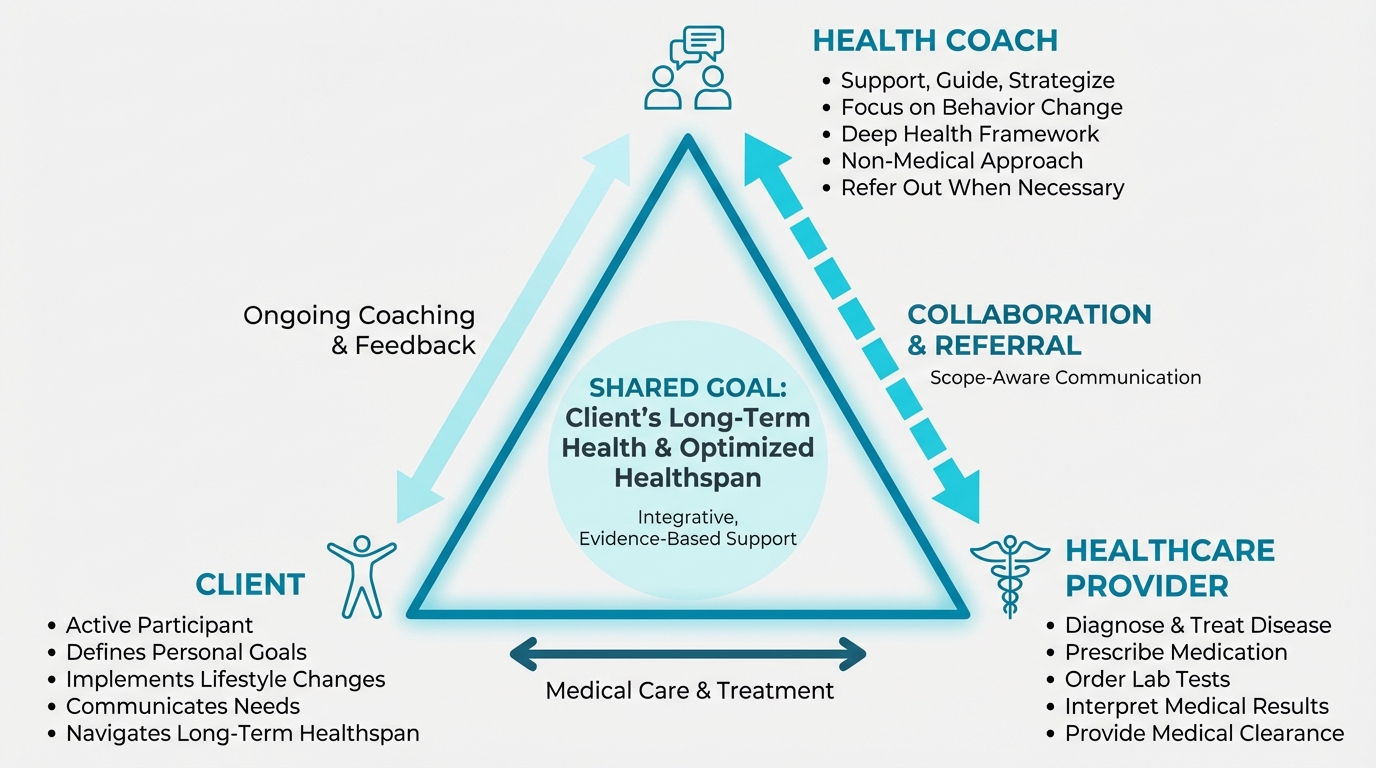
Figure: Coach + Client + Healthcare Provider triangle showing roles and relationships
It's not one-size-fits-all protocols. Every client is different. The best longevity plan is the one the client can actually stick to, not the one that looks perfect on paper.
[CHONK: Why Longevity Coaching Matters Now]
Why Longevity Coaching Matters Now
The world is aging fast, and that creates both a crisis and an opportunity.
The Numbers
By 2030, about 1.4 billion people will be 60 or older. By 2050, 1 in 6 people globally will be over 65.⁵ In the United States alone, about 10,000 people turn 65 every single day.
As people age, chronic disease becomes the norm, not the exception. In the United States, 93 percent of adults 65 and older have at least one chronic condition.¹ The most common? Heart disease, stroke, cancer, type 2 diabetes, and chronic lung disease. And here's what matters: most of these are preventable through lifestyle changes.
Despite overwhelming evidence that lifestyle changes can prevent chronic disease, prevention remains massively underfunded. In OECD countries, prevention receives only about 3 percent of health budgets.⁶ The healthcare system is reactive—it treats people after they get sick.
But lifestyle interventions work. Research consistently shows that lifestyle programs reduce progression to type 2 diabetes by approximately 24-25 percent in high-risk populations, reduce cardiovascular risk factors, and improve quality of life.⁷⁻⁹
This is where coaches make a real difference. We fill the gap between what people need to know and what they can actually do.
Your Role
Think of yourself as the "Project Manager" of your client's longevity journey.
The client is the CEO—they make the decisions, set the priorities, and own the outcomes. The physician is the Medical Expert—they diagnose, prescribe, and manage risk. You're the Project Manager—you help the client execute their plan, navigate obstacles, and stay on track.
Your job is to:
- Translate science into action: "Here's what the research says, and here's how we can apply it to your life."
- Support behavior change: "I know this is hard. Let's figure out what's getting in the way."
- Provide accountability: "How did last week go? What worked? What didn't?"
- Stay grounded: "Yes, that new supplement sounds exciting, but let's focus on sleep, exercise, and nutrition first—the Big Rocks."
You're not trying to be a doctor or a scientist. You're trying to be a great coach who happens to specialize in longevity.
[CHONK: Coaching in Practice - Reframing for Younger Clients]
Coaching in Practice: "I'm Too Young for This"
You'll hear this from clients in their 30s and 40s: "Longevity? That's for old people."
Don't argue. Meet them where they are.
What NOT to do:
❌ "Actually, biological aging starts in your 20s, and the research shows that by 35..."
Why it doesn't work: You're answering a question they didn't ask. They'll tune out.
What TO do:
✅ Get curious, then reframe to "feeling great now."
Sample dialogue:
Coach: "What made you reach out for coaching in the first place?"
Client: "I want more energy. I'm just tired all the time lately."
Coach: "Got it. Everything we do to improve your energy now is the same stuff that keeps you feeling great at 50, 60, 70. We're not doing 'anti-aging.' We're doing 'feel awesome today.' The future benefits are a bonus."
Client: "Okay, that actually makes sense."
Key takeaway: Start with their goals, not yours. The science is the same; the language changes.
[CHONK: The PN Approach to Longevity]
The PN Approach to Longevity
Precision Nutrition's approach to longevity coaching is different. Here's how.
Evidence-Based, Not Evidence-Bound
We follow the science and prioritize strong evidence—systematic reviews, meta-analyses, large cohort studies—when it's available. We cite our sources and we're transparent about what we know and what we don't know.
But we're not rigid about it. We recognize that science evolves, individual responses vary, and there are gaps in the research. We use evidence as a guide, not a straitjacket.
Client-Centered, Not Protocol-Centered
"The best longevity plan is the one the client can stick to."
That's our mantra. We don't start with a protocol and force the client to fit it. We start with the client's life, values, constraints, and goals, then build a plan that works for them.
Research backs this up. Client-centered coaching—characterized by collaborative goal-setting, motivational interviewing, and autonomy support—consistently improves health behaviors and outcomes compared to prescriptive approaches.¹²
Deep Health First
Longevity isn't just about physical health. It's about thriving in all six dimensions of Deep Health: Physical, Emotional, Mental, Social, Environmental, and Existential.
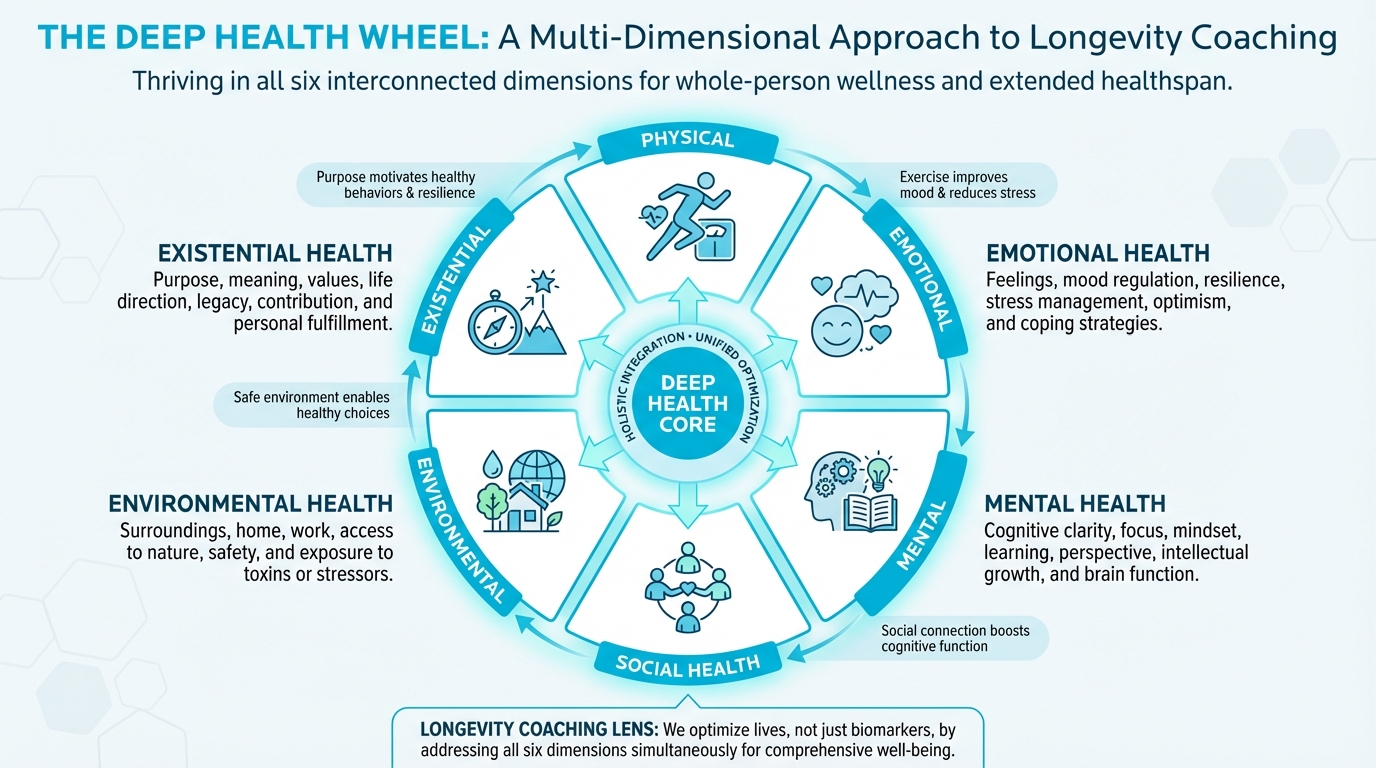
Figure: Six dimensions arranged as interconnected wheel/hexagon
We never sacrifice mental or social health for 1 percent better physical metrics. If a "perfect" nutrition plan destroys a client's social life or creates anxiety, it's not perfect—it's harmful.
The research supports this multi-dimensional approach: social connection, purpose in life, and optimism predict longevity independently of health behaviors.¹³⁻¹⁵ Social isolation increases mortality risk by about 30-35 percent. Purpose in life reduces all-cause mortality by about 17 percent.
Physical health matters. But it's not the only thing that matters.
You'll learn the full Deep Health framework in Chapter 1.3. For now, the key insight is simple: we coach the whole person, not just their biomarkers.
| For DIY Learners |
|---|
| Applying this to yourself: Take a moment to rate your own Deep Health. On a scale of 1-10, how are you doing in each dimension: Physical, Emotional, Mental, Social, Environmental, Existential? Which dimension is your strength? Which one, if improved, would have the biggest ripple effect on the others? This quick self-assessment gives you a starting point for your own longevity journey. |
Compassionate & Realistic
Change is hard, progress is non-linear, and setbacks are normal. We coach with empathy, not judgment.
We focus on "Big Rocks" before "Sand." The Big Rocks are the high-impact interventions that get most of the results: sleep, exercise, nutrition, stress management. The Sand is the low-impact stuff that gets a lot of attention: exotic supplements, cold plunges, expensive gadgets.
We're not saying the Sand is worthless. Some of it has promise. But if a client isn't sleeping well or exercising regularly, adding supplements isn't going to move the needle much. Get the Big Rocks in place first.
(You'll hear us say this a lot—it's that important.)
Scope-Aware
We are coaches, not doctors. We stay in our lane.
The Triangle of Care model clarifies our role:
- Client (CEO): Makes decisions, sets priorities, owns outcomes
- Coach (Project Manager): Helps execute the plan, navigates obstacles, provides support
- Physician (Medical Expert): Diagnoses, prescribes, manages risk
We collaborate, we don't compete. When a client needs medical attention, we refer them to their physician. When a physician recommends lifestyle changes, we help the client implement them. It's a team effort.
[CHONK: Coaching in Practice - Reframing Anti-Aging Expectations]
Coaching in Practice: "I Want to Reverse Aging"
Clients come in with all kinds of expectations. Some want to "turn back the clock" or "reverse their biological age by 10 years."
Don't argue with the goal. Explore what's underneath it.
What NOT to do:
❌ "Actually, aging can't be reversed. Let me explain..."
Why it doesn't work: You've made them wrong. They'll get defensive.
What TO do:
✅ Validate the feeling, then reframe to "building resilience."
Sample dialogue:
Coach: "Tell me more—what would it mean for you to feel 10 years younger?"
Client: "I'd have more energy. I wouldn't feel so... worn down all the time."
Coach: "That's exactly what we're going for. We're not fighting the clock. We're building resilience and vitality. What do you want to be able to do at 60, 70, 80?"
Client: "Play with my grandkids. Travel. Stay independent."
Coach: "Perfect. That's our roadmap. Let's work backward from there."
Key takeaway: Reframe from "fighting decline" to "building capacity." Focus on what clients can control.
[CHONK: What You'll Learn]
What You'll Learn in This Certification
This certification will teach you the science, the methods, and the coaching skills you need to help clients optimize for longevity.
The Four Units
Unit 1: Foundations (You are here!)
This unit covers the science of aging, the philosophy of longevity coaching, and the Precision Nutrition approach. You'll learn the hallmarks of aging, how to evaluate evidence, the Deep Health framework, and scope of practice.
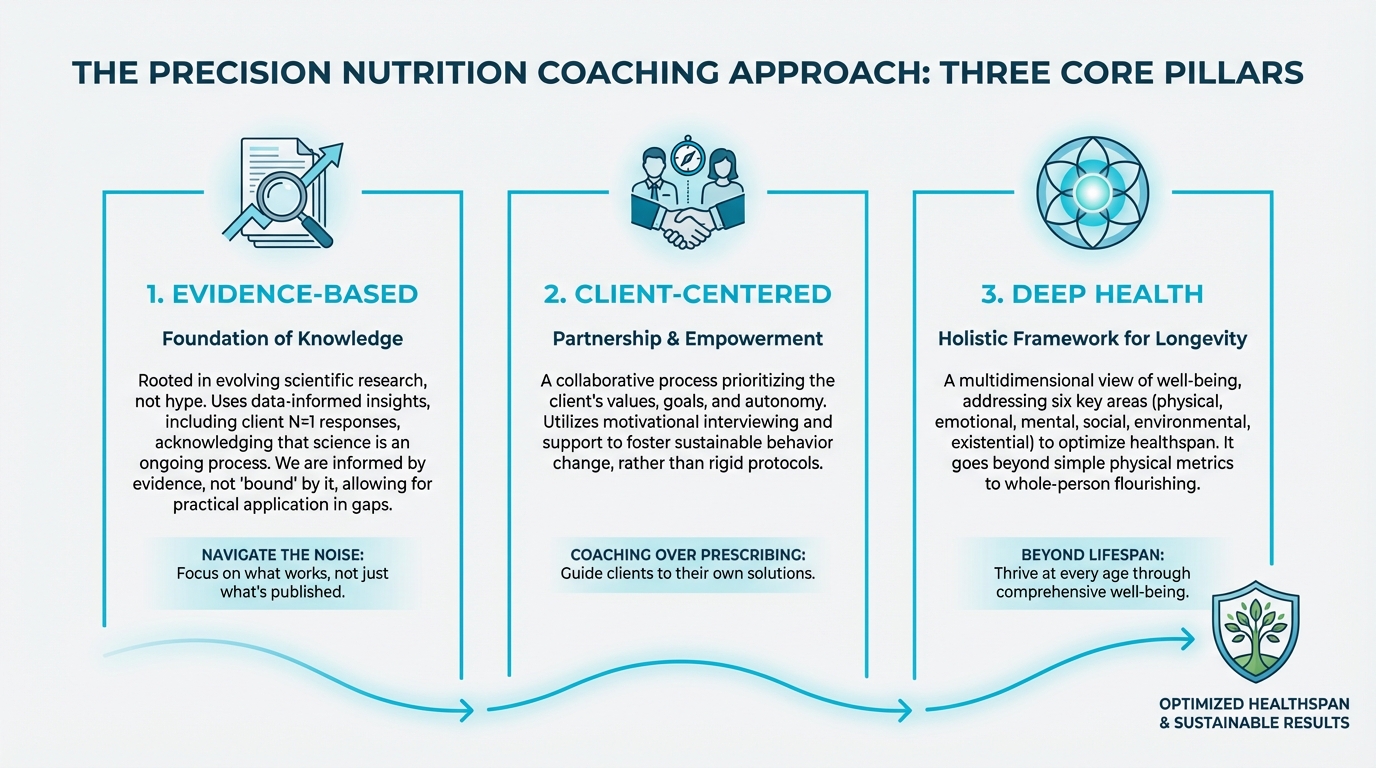
Figure: Evidence + Client-Centered + Deep Health pillars
Unit 2: Core Interventions
This unit covers the "what"—the specific interventions that support longevity: nutrition, exercise, sleep, stress management, and environmental factors.
Unit 3: Advanced Topics
This unit dives deeper: disease prevention, supplements and longevity products, hormonal health, and special populations.
Unit 4: The Practice
This unit focuses on integration and application: case studies, the business of longevity coaching, ethics, and continuing education.
How the Course Works
Each chapter includes clear explanations, evidence-based recommendations, practical coaching guidance, "Coaching in Practice" scenarios, and study guide questions.
By the end, you'll be able to:
- Explain longevity science in plain English
- Design personalized plans that fit clients' lives
- Coach clients through decades-long change
- Stay in scope and collaborate with healthcare providers
- Evaluate evidence critically, cutting through hype
[CHONK: Study Guide Questions]
Study Guide Questions
Here are some questions that can help you think through the material and prepare for the chapter exam.
-
Define healthspan and lifespan. How are they different? Why does healthspan matter more?
-
What are three things longevity coaching is NOT?
-
What does "client-centered, not protocol-centered" mean in practice?
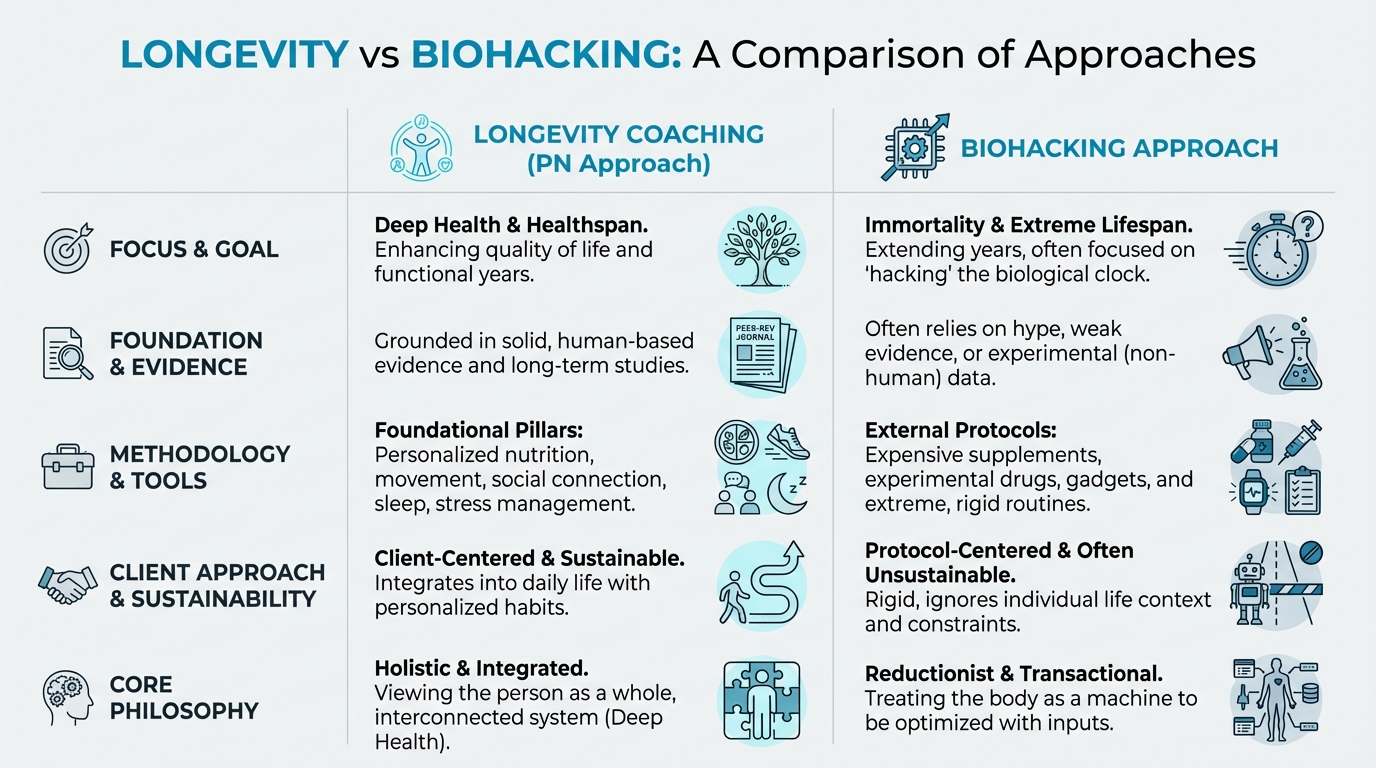
Figure: Side-by-side contrast of approaches
-
What is the "Triangle of Care"? Why is collaborative care important?
-
A client says they want to "reverse aging and live to 150." How would you reframe this?
-
What does "Big Rocks before Sand" mean? Give examples.
-
How would you explain to a 35-year-old client why they should care about longevity now?
Self-reflection questions:
-
What does thriving at 70, 80, and 90 look like for you personally? What activities and capabilities matter most to you?
-
What motivated you to take this course? Are you here primarily to coach others, to apply this to your own life, or both?
Deep Dives
Want to go deeper? These supplemental articles explore key topics from this chapter in more detail.
- The Science Behind Health Coaching Effectiveness: Research summary on why coaching works
- Case Study: 12-Month Client Transformation: Real example of longevity coaching journey
References
-
Watson KB, Wiltz JL, Nhim K, Kaufmann RB, Thomas CW, Greenlund KJ. Trends in Multiple Chronic Conditions Among US Adults, By Life Stage, Behavioral Risk Factor Surveillance System, 2013–2023. Preventing Chronic Disease. 2025;22. doi:10.5888/pcd22.240539
-
World Health Organization. Life expectancy and Healthy life expectancy (HALE). WHO Global Health Observatory; 2022. https://www.who.int/data/gho/data/themes/mortality-and-global-health-estimates/ghe-life-expectancy-and-healthy-life-expectancy
-
Garmany A, Terzic A. Healthspan-lifespan gap differs in magnitude and disease contribution across world regions. Communications Medicine. 2025;5(1). doi:10.1038/s43856-025-01111-2
-
World Health Organization. Ageing: Global population (WHO Q&A). 2025. https://www.who.int/features/qa/72/en/
-
OECD. Health at a Glance 2023. Health at a Glance. 2023. doi:10.1787/7a7afb35-en
-
Amiri S, Mahmood N, Junaidi S, Khan MA. Lifestyle interventions improving health-related quality of life: A systematic review and meta-analysis of randomized control trials. Journal of Education and Health Promotion. 2024;13(1). doi:10.4103/jehp.jehp_1156_23
-
Sagastume D, Siero I, Mertens E, Cottam J, Colizzi C, Peñalvo JL. The effectiveness of lifestyle interventions on type 2 diabetes and gestational diabetes incidence and cardiometabolic outcomes. eClinicalMedicine. 2022;53:101650. doi:10.1016/j.eclinm.2022.101650
-
Demissie GD, Birungi J, Shrestha A, Haregu T, Thirunavukkarasu S, Oldenburg B. The effectiveness of lifestyle interventions in reducing cardiovascular risk and risk factors in people with prediabetes. Nutrition, Metabolism and Cardiovascular Diseases. 2025;35(10):104130. doi:10.1016/j.numecd.2025.104130
-
Almulhim AN, Hartley H, Norman P, Caton SJ, Doğru OC, Goyder E. Behavioural Change Techniques in Health Coaching-Based Interventions for Type 2 Diabetes: A Systematic Review and Meta-Analysis. BMC Public Health. 2023;23(1). doi:10.1186/s12889-022-14874-3
-
Wang F, Gao Y, Han Z, Yu Y, Long Z, Jiang X, et al. A systematic review and meta-analysis of 90 cohort studies of social isolation, loneliness and mortality. Nature Human Behaviour. 2023;7(8):1307-1319. doi:10.1038/s41562-023-01617-6
-
Lee LO, James P, Zevon ES, Kim ES, Trudel-Fitzgerald C, Spiro A, et al. Optimism is associated with exceptional longevity in 2 epidemiologic cohorts of men and women. Proceedings of the National Academy of Sciences. 2019;116(37):18357-18362. doi:10.1073/pnas.1900712116
-
James P, Kim ES, Kubzansky LD, Zevon ES, Trudel-Fitzgerald C, Grodstein F. Optimism and Healthy Aging in Women. American Journal of Preventive Medicine. 2019;56(1):116-124. doi:10.1016/j.amepre.2018.07.037
Chapter 1.1 complete. Proceed to Chapter 1.2: The Biology of Aging.